I completed a four-day trip to my hometown in North Carolina, and back – and, as usual, there is so much material to write about that I mysteriously can write nothing at all. Just as when a tree bears more fruit than a busy, satiated person can consume – I feel glutted by the incidents and want to turn away from writing for a while. The most insignificant of them, however, is the thing that elbows me . . .
It’s the Waffle House experience. There was a retired sort of fellow who had been hired to be a “greeter” there; he was thin and dark around the gills, but full of energy and the seriousness of his job – he jumped to open the door for me in salutations of Good Morning! and Welcome to Waffle House! as I approached the door with my newspaper before the last 100-mile run of a 500-mile journey. He hurried to the only remaining table – a booth – where he cleared away plates and wiped the table clean, beckoned me to sit down while placing the plastic menu on the wet Formica top. I knew what I wanted as soon as the buxom woman with the raspy voice came over with the coffee pot and the honey moniker which she gave to everyone. She yelled out the well-rehearsed codes and equations that represented my order to the cook – and though he never acknowledged hearing her, she never doubted that he did.
I felt my kingdom undeservedly rally round me as I spread out the newspaper and she placed my drinks of coffee on one side and orange juice on the other – and I noticed the 6 people crammed into the 4-person booth in back of me and the 5 people crowded into the other booth in front of me. It was later, when my food was almost ready, that she apologetically leaned over and said, “Honey, now don’t feel ye need to do this, but would ye mind if we moved ye to a spot at the table o’er yonder so those four men might have a seat – but now honey, ye don’t need to 'cause it’s yer booth and ye was here b’for ‘em – don’t feel ye need to, honey.” And I saw four burly men standing outside the Waffle House talking to the friendly greeter because there wasn’t room for four such big men to stand inside the doorway while waiting for a seat . . .
So I said that I already felt guilty for having so much space to myself and that it would be fine to move – “Honey, ye don’t hafta . . . “ she repeated. I want to, and I was already trying to manage the coffee and newspaper when the friendly greeter came inside to help me with my orange juice and to escort me to my new, made-for-one, cozy seat in the back – and he gave me his profuse thanks all the while we walked – my generosity and such . . . No, not at all, I’m happy to . . . that sort of thing, back and forth.
My kind waitress brought the food and continued to care for me, even though this wasn’t her station, and she gave me thanks each time so that my new neighbors began to understand the story. That’s when I took notice of the corner where I was sitting – which had at one time been the "smoker’s section" of Waffle House, I presume – that is, before the laws in NC were changed last year to prohibit all that smoking indoors. But the smokers still remained – but without their "fix" – for they all had the eyes of withdrawal and trauma and reproof – eyes that had settled into sockets like sludge in a pond – suspended – eyes that reposed and fixed upon me – perhaps because of the animation I gave to eating and turning pages while they sat with fingers rendered motionless by the Law.
My waitress came back frequently to refill coffee and ask how I was doing. One of those times she swooped up the check and said, “Honey, ye don’t hafta pay this – they insist – now don’t ye say a word about’t ‘cause they insist” – and she was gone with my check and the coffee pot before I comprehended what she had meant by “they” and “insist” – that the four men had insisted on paying for my breakfast because I had given up my spacious booth for them . . . and what would I have said anyway?
I sat finishing my meal and drinking my coffee, all the while contemplating what I ought to do next – and all the while sensing that the smokers without their smokes were thinking the same thing – what’ll she do next? And then I came up with the plan to leave a nice tip for the friendly waitress since I felt the need to pass it on – this generosity of spirit. But I was not sitting in her station but rather in the smokers’ waitress’s station – and she had not yet acknowledged me. I think she had somehow taken on the demeanor or outlook of the smokers in her care – for she had large, dark pools around her eyes and a fishlike emptiness in her mouth, and she moved very slowly too. And so, after much thought, and as my perpetual onlookers waited in anticipation, I decided that when I left I would thank the table of four men and give them the tip large enough to cover the cost of my meal so they could “add it to the tip” for our waitress – and so I did, thanked them, and left the tip for our waitress with them – and of course they said they were more grateful than I was for having the booth to sit in, and that they would gratefully give her the tip – but then she passed by to refill their cups, and then she became grateful – and the booths full of people to either side noticed the exchange and, like ripples spreading in a pond, they too began to smile. I was feeling in the center of things too much, and so I began to back out of the door, but ran into the friendly greeter who in turn began the gratefulness cycle once again – and I said, No, you are the one who started this whole wheel turning with your friendliness at the door – and he just smiled as though already understanding the seriousness of his job – and it seemed the whole place became abuzz with gratefulness. When I looked over to the smoking section, I saw a different kind of trans-fixation in the eyes – they were still transfixed, but it was almost like someone had budged them loose from their orbit just a little bit and they had been able to move their eyes to a place outside their own realm for just that instant.
I emerged from the magical Waffle House and got into my car, feeling that I had just left some swirling tunnel of light – a kaleidoscope where various colors will mix and match, one upon another, to form patterns of hearts or clovers, stars, rings or golden links – the more you turn it . . .
It seems like such a small experience – and I really have more important ones to write about, ones that could add to the book I’m working on but can’t settle into this morning. I felt a curiosity as to whether the place really existed or was just a figment of my imagination – and so I got online to find it – and there it is – The Waffle House at 164 Tunnel Road – really – in Asheville, North Carolina.
Bread baking and writing go "hand in hand." What I learn from one, I gain in the other. Using my past experience of creating beautiful, delicious, yet healthful and uncompromised breads, I now set to the task of writing my first book. I say, "If I could make whole wheat rise . . . "
Monday, May 17, 2010
Thursday, May 6, 2010
Willa Cather Comes Home
If it were possible, I would buy the Willa Cather birthplace – and I would renovate it – but . . . then, what would I do? Would it be possible to live and write in the birth home of my favorite American author? That is an unbelievable thought – and one I imagined as I stood outside the Cather homestead in Gore, Virginia last week and watched as the high-powered, 18-wheel trucks roared past the property. I looked across the street at the old motel with the “day traders” coming and going from parking lot to doorway – and saw them look back at me as though I, the one taking pictures of an author’s birthplace, were the one out of place in that picture. Something has to be done, but I don’t know what . . .
The abandoned birthplace of my favorite American author, Willa Cather, distresses me each time I go there – which has been only twice – but I feel I’ve been there many more times because it weighs so heavily on my mind. The first visit, a year ago, I drove two hours from my home on a sunny spring day, expecting to see a pristine home where a young tour guide might escort me through upstairs bedrooms and provide facts and nuances about the life of a young Willa Cather. Instead, I found a condemned shack that could barely support the little metal plaque declaring it a Virginia Historic Landmark. Thinking there was some mistake, I went to a nearby gas station where the regulars sat along a stoop just inside the door and told me, unofficially, far more than I had asked for. The current owner seemed to be waiting for the termites to finish the job, one man told me while the others concurred – so he could legally clear away the mess and sell the property located on the only highway through town. Since the house is a registered historic landmark, however, the owner’s hands are tied for the time being – until the termites finish their job. He is under no obligation to preserve the home at his expense – and neither is the State of Virginia, I suppose. For now, the house is in waiting. The men in their overalls thought I had come to buy the house – or write a story about it – or do something to bring attention to their town’s only legacy. No, I just wanted to visit it. “We sure could use the tourism here, right on the highway like it is,” said one man. “Look on the website and see what they’ve done to her in Nebraska!” shouted a woman from behind the counter. “And we’re only 80 miles from D.C.,” said another.
I, like many others I suppose, have always assumed that Willa Cather came from Nebraska. The subject matter of her most popular books is about German and Czech immigrants who came to settle and tame the unforgiving prairie lands of Nebraska. Many died of starvation. Cather experienced their stories firsthand because her own family had moved there from Virginia in 1883 when she was only nine years old. But she left Nebraska when she was 18 to pursue a college degree and subsequent journalism career in Pittsburg.
The small town of Red Cloud, Nebraska has made a sweeping claim to their author, as noted on the official website of the Willa Cather Foundation – http://www.willacather.org/ Red Cloud is host to house tours, walking tours, parades, annual conferences, and writing contests. Grandaughters of people who knew the Cather family give speeches at various literary functions. There are bed-and-breakfast homes and restaurants in her honor. Willa Cather is big business in Red Cloud.
Cather’s first nine years of life, however – and six generations of Cathers before her – were lived in a tiny town in the Shenandoah Valley called Gore, VA.
I was only 15 years old when I read my first Willa Cather novel, "My Antonia" – soon followed by anything else I could get my hands on. I’ve never forgotten her description of the old Bohemian, Mr. Shimerda, and his violin . . . and what happened to him. It wouldn’t be a far fetch to say that she is a primary reason I came to love literature and to hold high hopes of someday writing even one short story with the impact she gave to writing.
Willa Cather has said this: “Most of the basic material a writer works with is acquired before the age of fifteen.” Why would she have said that if her first nine years in Virginia meant nothing to her? The last book of her life, "Sapphira and the Slave Girl," takes place in Gore,Virginia and was written in 1940 before her sudden death of a cerebral hemorrhage at age 74. It's as though she had come full circle -- back to Virginia in her writing.
I stood in her front yard thinking that Willa Cather may have returned to this very site before writing her last book. It is said she spent nine years visiting and researching the missions of New Mexico before she sat down to write "Death Comes for the Archbishop" – the actual writing took only three months. That’s how she worked. She would spend many years visiting, thinking, and absorbing a place before putting it to paper. I contend – though the guys at the gas station didn’t tell me this – that she came to her birth home many times before writing her final novel. She may have stayed in the house – for I was told that Cather family members owned and lived in the house until a few decades ago. Maybe she sketched an outline of her final book in an upstairs bedroom. Perhaps she walked along Back Creek, only a trickle now, and remembered the days when she played or tended her six younger siblings there. She may have planned more books about her birthplace . . .
I’m sorry that the State of Virginia has neglected this landmark and legacy of yours, Ms. Cather. Thank you – your books have meant the world to me. That’s what I said aloud to the spirit of Willa Cather as I stood in her front yard amid the din of a passing truck.
"Men travel faster now, but I do not know if they go to better things,” she has said.
The abandoned birthplace of my favorite American author, Willa Cather, distresses me each time I go there – which has been only twice – but I feel I’ve been there many more times because it weighs so heavily on my mind. The first visit, a year ago, I drove two hours from my home on a sunny spring day, expecting to see a pristine home where a young tour guide might escort me through upstairs bedrooms and provide facts and nuances about the life of a young Willa Cather. Instead, I found a condemned shack that could barely support the little metal plaque declaring it a Virginia Historic Landmark. Thinking there was some mistake, I went to a nearby gas station where the regulars sat along a stoop just inside the door and told me, unofficially, far more than I had asked for. The current owner seemed to be waiting for the termites to finish the job, one man told me while the others concurred – so he could legally clear away the mess and sell the property located on the only highway through town. Since the house is a registered historic landmark, however, the owner’s hands are tied for the time being – until the termites finish their job. He is under no obligation to preserve the home at his expense – and neither is the State of Virginia, I suppose. For now, the house is in waiting. The men in their overalls thought I had come to buy the house – or write a story about it – or do something to bring attention to their town’s only legacy. No, I just wanted to visit it. “We sure could use the tourism here, right on the highway like it is,” said one man. “Look on the website and see what they’ve done to her in Nebraska!” shouted a woman from behind the counter. “And we’re only 80 miles from D.C.,” said another.
I, like many others I suppose, have always assumed that Willa Cather came from Nebraska. The subject matter of her most popular books is about German and Czech immigrants who came to settle and tame the unforgiving prairie lands of Nebraska. Many died of starvation. Cather experienced their stories firsthand because her own family had moved there from Virginia in 1883 when she was only nine years old. But she left Nebraska when she was 18 to pursue a college degree and subsequent journalism career in Pittsburg.
The small town of Red Cloud, Nebraska has made a sweeping claim to their author, as noted on the official website of the Willa Cather Foundation – http://www.willacather.org/ Red Cloud is host to house tours, walking tours, parades, annual conferences, and writing contests. Grandaughters of people who knew the Cather family give speeches at various literary functions. There are bed-and-breakfast homes and restaurants in her honor. Willa Cather is big business in Red Cloud.
Cather’s first nine years of life, however – and six generations of Cathers before her – were lived in a tiny town in the Shenandoah Valley called Gore, VA.
I was only 15 years old when I read my first Willa Cather novel, "My Antonia" – soon followed by anything else I could get my hands on. I’ve never forgotten her description of the old Bohemian, Mr. Shimerda, and his violin . . . and what happened to him. It wouldn’t be a far fetch to say that she is a primary reason I came to love literature and to hold high hopes of someday writing even one short story with the impact she gave to writing.
Willa Cather has said this: “Most of the basic material a writer works with is acquired before the age of fifteen.” Why would she have said that if her first nine years in Virginia meant nothing to her? The last book of her life, "Sapphira and the Slave Girl," takes place in Gore,Virginia and was written in 1940 before her sudden death of a cerebral hemorrhage at age 74. It's as though she had come full circle -- back to Virginia in her writing.
I stood in her front yard thinking that Willa Cather may have returned to this very site before writing her last book. It is said she spent nine years visiting and researching the missions of New Mexico before she sat down to write "Death Comes for the Archbishop" – the actual writing took only three months. That’s how she worked. She would spend many years visiting, thinking, and absorbing a place before putting it to paper. I contend – though the guys at the gas station didn’t tell me this – that she came to her birth home many times before writing her final novel. She may have stayed in the house – for I was told that Cather family members owned and lived in the house until a few decades ago. Maybe she sketched an outline of her final book in an upstairs bedroom. Perhaps she walked along Back Creek, only a trickle now, and remembered the days when she played or tended her six younger siblings there. She may have planned more books about her birthplace . . .
I’m sorry that the State of Virginia has neglected this landmark and legacy of yours, Ms. Cather. Thank you – your books have meant the world to me. That’s what I said aloud to the spirit of Willa Cather as I stood in her front yard amid the din of a passing truck.
"Men travel faster now, but I do not know if they go to better things,” she has said.
Monday, April 19, 2010
Milk or Meat
I took a deliberate break from writing on Friday to do a thing I’ve never done before – go to an art gallery – which ended up being three art galleries since the first one had none of the intimidating factors I feared it might. So I went to three art galleries – but this one gallery – this one artist – his cow paintings were the thing that grabbed me. Now, how can I say that? I don’t know much about art – and so I can only speak out of a sense of wonder at what I felt, and give reference to his website for a look at the real paintings: http://www.osterhausart.com/
And so, this man’s cow paintings – they captured the “cow presence” – my unprofessional opinion – and I would easily have taken one home if I’d had $3,000 or more, but . . .
this is where I think of the two women who came whirling through the gallery while I stood in silent dialogue with one cow – they came whirling through together as though on a shopping spree to find just the right scarf or shoe, or fabric or lamp – they did not stop at any one cow, but rather whirled by and around me with such comments as, “That one would bring out the yellow in your drapes” – or, “This one would accent the green lamp” – or, “You need a touch of red in that room, here it is” . . . but the main shopper, close behind, did not seem overly impressed by her friend’s “good eye” – or the cow’s – and so they whirled through and out before the one cow and I could finish our silent understanding . . .
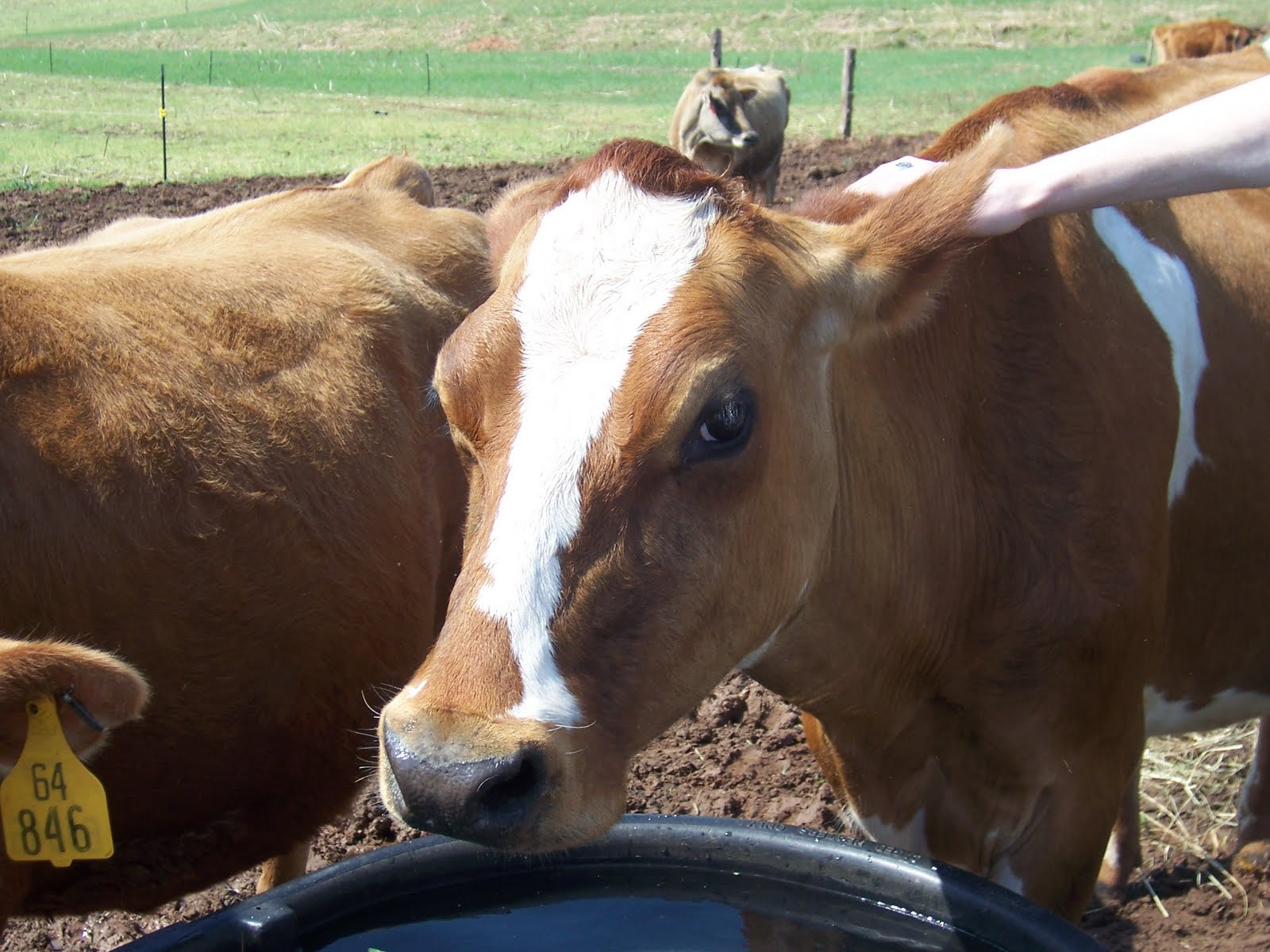
“Milk or meat, which one do you want?” That’s what the one cow seemed to be saying to me once the women had whirled away. I could see it in those cow-brown eyes that might have come up close to a fence to share dialogue or a careful blink with me . . . and it reminded me of all these cow pictures I took when I was at the Benedictine monastery in the Shenandoah Valley last springtime. The Benedictines, also called Trappist monks, are a priestly order which dates back to their founder, St. Benedict of the early 6th century. In addition to vows of silence and poverty, they have taken a vow of hospitality – which includes hosting those of us who live in this noisy world and would like to experience an occasional week of silence in the bucolic bounty of their farmland and monastic world.
And so, as I took my long walks along the Shenan- doah River last spring, the cows would amble over to the fence with little to say or do except for the presentation of themselves. One curious cow would begin the amble – and then you’d think a dinner bell had been rung, for they’d all begin to amble as the first one had – and so, if I waited long enough, they’d all make it to the fence for a good staring session. Many animals and birds have a kind of wisdom in the eye – but not the cow. They know nothing more about me than my desire for milk or meat.
I think the cow is the most resigned of all the creatures. They have no fight left in them. They have no flight either. They have lived thousands of years within fenced lines that are monitored by maidens or dames, farmers or “hands” – and through evolutionary learning they know that they are one thing or the other – milk or meat – and so they’ve resigned to say nothing more about it.
That’s the look I got from that one cow in the gallery. I ambled on to the next cow – and though her colors be different and her snapshot painting be taken at dusk or dawn, and though her profile be tilted or straight-on – still, she had that one question in her eye about the milk or the meat. But I never got bored of looking at the same question. Each cow is like a different, but familiar, breed of motherly love that has resigned itself to always give and never take. There’s no boredom in looking at her because taking is never boring for the taker – we can take till kingdom come and always think it is novel and fresh. Only the cow herself has grown bored with the equation.
Now, as for color – all the cows he painted, even the black and white ones, had so many feminine colors in their coats – or rather, hides – pinks, lavenders, purples, cantaloupe, chartreuse, and chive . . . I can’t say how it is that I could stand at one end of the gallery and look straight into the brown of a cow’s eyes at the other end of the gallery – and swear that she was a brown cow – only to walk closer and begin to see what the two women had come to see – lavender strokes and pink swirls, a curlicue of red, dabs of green, blue, or musk – as though the artist had been cleaning off his pallet on the cow’s hide instead of painting her. And, I thought, how can all those many colors converge – as you walk backwards and away from her – to make one brown cow with the eye of one question? How can a person, working in close range to a large canvas, think to add lavender and pink and chartreuse to a cow that he meant all along to be one brown cow . . . and how do you bury that one question in the cow’s eye only by adding a small blotch of red and a slice of white? It reminds me of what Barbara Ueland says in her book, “If You Want to Write” – she calls it the "fourth dimension" of writing – a type of inspiration that pervades the sentence but can’t be found in the words themselves no matter how much you scratch at the page – it’s just there.
Similarly, as I looked at the paintings, I could almost smell the fresh growing spring grass and taste the raw milk that I remembered from my grandfather’s farm. I also thought of the Chartreuse liqueur which I keep in the food cabinet – that wonderful “elixir of life” that was developed 400 or 500 years ago among the Carthusian monks in the French Alps. They are known for their silence, animal husbandry, heritage cheeses, and this elixir made from 130 herbal extracts – described as having hints of everything bucolic: citrus, violet, honey, thyme, rosemary, jasmine, coriander . . . on and on, 130 herbs and flowers. They say only three monks are alive today who know this secret recipe, and all three have taken a vow of silence in the Grande Chartreuse Monastery in the French Alps. The websites that market Chartreuse liqueur jokingly tell us that the Carthusian monks spent 500 years sampling and contemplating this 110-proof liqueur before declaring it a perfection which “redefines complexity.” But I think it took 500 years of looking closely into the eye of one cow to understand multiplicity where others saw only brown.
And so, this man’s cow paintings – they captured the “cow presence” – my unprofessional opinion – and I would easily have taken one home if I’d had $3,000 or more, but . . .
this is where I think of the two women who came whirling through the gallery while I stood in silent dialogue with one cow – they came whirling through together as though on a shopping spree to find just the right scarf or shoe, or fabric or lamp – they did not stop at any one cow, but rather whirled by and around me with such comments as, “That one would bring out the yellow in your drapes” – or, “This one would accent the green lamp” – or, “You need a touch of red in that room, here it is” . . . but the main shopper, close behind, did not seem overly impressed by her friend’s “good eye” – or the cow’s – and so they whirled through and out before the one cow and I could finish our silent understanding . . .
“Milk or meat, which one do you want?” That’s what the one cow seemed to be saying to me once the women had whirled away. I could see it in those cow-brown eyes that might have come up close to a fence to share dialogue or a careful blink with me . . . and it reminded me of all these cow pictures I took when I was at the Benedictine monastery in the Shenandoah Valley last springtime. The Benedictines, also called Trappist monks, are a priestly order which dates back to their founder, St. Benedict of the early 6th century. In addition to vows of silence and poverty, they have taken a vow of hospitality – which includes hosting those of us who live in this noisy world and would like to experience an occasional week of silence in the bucolic bounty of their farmland and monastic world.
And so, as I took my long walks along the Shenan- doah River last spring, the cows would amble over to the fence with little to say or do except for the presentation of themselves. One curious cow would begin the amble – and then you’d think a dinner bell had been rung, for they’d all begin to amble as the first one had – and so, if I waited long enough, they’d all make it to the fence for a good staring session. Many animals and birds have a kind of wisdom in the eye – but not the cow. They know nothing more about me than my desire for milk or meat.
I think the cow is the most resigned of all the creatures. They have no fight left in them. They have no flight either. They have lived thousands of years within fenced lines that are monitored by maidens or dames, farmers or “hands” – and through evolutionary learning they know that they are one thing or the other – milk or meat – and so they’ve resigned to say nothing more about it.
That’s the look I got from that one cow in the gallery. I ambled on to the next cow – and though her colors be different and her snapshot painting be taken at dusk or dawn, and though her profile be tilted or straight-on – still, she had that one question in her eye about the milk or the meat. But I never got bored of looking at the same question. Each cow is like a different, but familiar, breed of motherly love that has resigned itself to always give and never take. There’s no boredom in looking at her because taking is never boring for the taker – we can take till kingdom come and always think it is novel and fresh. Only the cow herself has grown bored with the equation.
Now, as for color – all the cows he painted, even the black and white ones, had so many feminine colors in their coats – or rather, hides – pinks, lavenders, purples, cantaloupe, chartreuse, and chive . . . I can’t say how it is that I could stand at one end of the gallery and look straight into the brown of a cow’s eyes at the other end of the gallery – and swear that she was a brown cow – only to walk closer and begin to see what the two women had come to see – lavender strokes and pink swirls, a curlicue of red, dabs of green, blue, or musk – as though the artist had been cleaning off his pallet on the cow’s hide instead of painting her. And, I thought, how can all those many colors converge – as you walk backwards and away from her – to make one brown cow with the eye of one question? How can a person, working in close range to a large canvas, think to add lavender and pink and chartreuse to a cow that he meant all along to be one brown cow . . . and how do you bury that one question in the cow’s eye only by adding a small blotch of red and a slice of white? It reminds me of what Barbara Ueland says in her book, “If You Want to Write” – she calls it the "fourth dimension" of writing – a type of inspiration that pervades the sentence but can’t be found in the words themselves no matter how much you scratch at the page – it’s just there.
Similarly, as I looked at the paintings, I could almost smell the fresh growing spring grass and taste the raw milk that I remembered from my grandfather’s farm. I also thought of the Chartreuse liqueur which I keep in the food cabinet – that wonderful “elixir of life” that was developed 400 or 500 years ago among the Carthusian monks in the French Alps. They are known for their silence, animal husbandry, heritage cheeses, and this elixir made from 130 herbal extracts – described as having hints of everything bucolic: citrus, violet, honey, thyme, rosemary, jasmine, coriander . . . on and on, 130 herbs and flowers. They say only three monks are alive today who know this secret recipe, and all three have taken a vow of silence in the Grande Chartreuse Monastery in the French Alps. The websites that market Chartreuse liqueur jokingly tell us that the Carthusian monks spent 500 years sampling and contemplating this 110-proof liqueur before declaring it a perfection which “redefines complexity.” But I think it took 500 years of looking closely into the eye of one cow to understand multiplicity where others saw only brown.
Thursday, April 15, 2010
Great Indices
A couple years ago I took a techno- logy class in which the professor opened the semester by asking us, “What forms of technology do you see around you?” And of course we adult students, like children with an eager eye to please, called out all those things we could see in the technology room including some in our own possession. It was a trick question – as we should have known – for she then proceeded to pick up a pencil and ask if this was not also a form of technology – her segue into the definition of technology: any tool that can facilitate and better our lives. The rest of the semester was devoted to computers and all that they can do for our lives, but the presentation of the pencil as a form of technology was one I could easily grasp and remember. I’m a big fan of the pencil, the paper clip, the pen, and the black and white composition book – technology at its best. However,
I’ve become greatly disturbed these past few weeks about the index card. The index card has also facilitated my life. They are good for note taking and list making, of course – but also for bookmarks, packing labels, recipe cards, vocabulary lists, signs, flashcards, to-do lists, notes to oneself or others . . . they can be cut into any size, shuffled, laid out on a table, stacked and rubber banded, paper clipped, grouped and regrouped . . . and they will last for many years . . . and you can write on both sides. I’ve never been without a stock of index cards.
At first I thought I had made a terrible mistake – that Good Friday, two weeks ago – when I came home and unwrapped my new pack of index cards. These were not index cards, but rather rectangles of paper no stockier than printing paper. They were flaccid, couldn’t be shuffled at all, and when held up to the window – the window panes shown through.
My to-do list fell to the side, and a Good Friday quest began . . . two superstores, two office supply stores, an old drug store, a grocery store, and one fancy pen and stationery shop . . . and no quality index cards. They are all made of paper-stock paper – and I don’t like the bold colors and odd stripes.
Once home, I cranked up my “advanced technology” to go online and see if I could perhaps order this “simple technology.” This is what I’ve learned: 1) I’m not the only one who has noticed the sudden lack of quality in index cards – there is at least one forum devoted to this topic – and people are angry. 2) The index card goes back thousands of years – its name derives from a Greek word, to show; and from the Latin, to point, to inform – much like our index finger. Medieval monks used them to jot down important points. 3) They are called index cards because they are made of card-stock paper. 4) The standard index card is 3x5 inches; wooden file boxes were made to accommodate this card when creating the first library card catalogue in 1820 – which was the google of its day. 5) The general public wanted these cards too – and so they became available to all. 6) No one knows exactly when the card was cheapened – but it’s been recent – and it has been pervasive – Mead, Oxford, all the office supply brands are now made of cheap paper-stock paper. 7) However, the original library card, Levenger, has not changed – but it’s hard to find even online, and then it costs plenty, about $28 per 500 cards – and it is currently backordered indefinitely. Another brand, Exacompta, can be bought for $8 per 100 cards, not including shipping charges from France.
It’s interesting that the iPad made its debut on the same day that I quested for index cards. They say that 120,000 iPads sold the first day, and upwards of one million sold by the end of the first week. What does this indicate? I’m tempted to conclude that the decline of the quality index card is indicative of the decline of a nation, its culture, its priorities – at least one computer for every man, woman and child in America – but not a single quality index card to be had. But I remember what one guy said in the forum on index cards: “It’s an index card! Get on with your life!” He then provided a five-paragraph review of every index card he’s ever tried, concluding that, for the price, the Oxford Pentaflex was good enough for him – "chopped up printing paper that it is," he said. And that gave me an idea . . .
If manufacturers can chop up paper-stock paper to make their cheap index cards, then why can't the common person cut up card-stock paper to make an old-fashioned quality index card?
The young man at Kinko’s knew exactly what I was talking about. He showed me his portfolio of card stock paper, adroitly calculated how many 3x5 and 4x6 cards he could cut from a standard sheet, asked me how many cards I’d like, which colors, gave me a price, cut the paper in two minutes, boxed them up. I took out two cards, one in each hand, and snapped them in the air – yes, snapped – not flapped – but snapped.
"I never thought I’d have to make my own index cards," I said to him gratefully.
“Oh, believe me, you’re not the only one . . .” he said.
And that’s when I realized: 1) The common person does notice when our “little technology” has been made cheap; we cannot be hoodwinked by big manufacturers. 2) Big technology will never totally displace quality little technology. 3) If manufacturers cannot provide us with our little technology – we will make it ourselves – and they will lose an important market sector.
I’ve become greatly disturbed these past few weeks about the index card. The index card has also facilitated my life. They are good for note taking and list making, of course – but also for bookmarks, packing labels, recipe cards, vocabulary lists, signs, flashcards, to-do lists, notes to oneself or others . . . they can be cut into any size, shuffled, laid out on a table, stacked and rubber banded, paper clipped, grouped and regrouped . . . and they will last for many years . . . and you can write on both sides. I’ve never been without a stock of index cards.
At first I thought I had made a terrible mistake – that Good Friday, two weeks ago – when I came home and unwrapped my new pack of index cards. These were not index cards, but rather rectangles of paper no stockier than printing paper. They were flaccid, couldn’t be shuffled at all, and when held up to the window – the window panes shown through.
My to-do list fell to the side, and a Good Friday quest began . . . two superstores, two office supply stores, an old drug store, a grocery store, and one fancy pen and stationery shop . . . and no quality index cards. They are all made of paper-stock paper – and I don’t like the bold colors and odd stripes.
Once home, I cranked up my “advanced technology” to go online and see if I could perhaps order this “simple technology.” This is what I’ve learned: 1) I’m not the only one who has noticed the sudden lack of quality in index cards – there is at least one forum devoted to this topic – and people are angry. 2) The index card goes back thousands of years – its name derives from a Greek word, to show; and from the Latin, to point, to inform – much like our index finger. Medieval monks used them to jot down important points. 3) They are called index cards because they are made of card-stock paper. 4) The standard index card is 3x5 inches; wooden file boxes were made to accommodate this card when creating the first library card catalogue in 1820 – which was the google of its day. 5) The general public wanted these cards too – and so they became available to all. 6) No one knows exactly when the card was cheapened – but it’s been recent – and it has been pervasive – Mead, Oxford, all the office supply brands are now made of cheap paper-stock paper. 7) However, the original library card, Levenger, has not changed – but it’s hard to find even online, and then it costs plenty, about $28 per 500 cards – and it is currently backordered indefinitely. Another brand, Exacompta, can be bought for $8 per 100 cards, not including shipping charges from France.
It’s interesting that the iPad made its debut on the same day that I quested for index cards. They say that 120,000 iPads sold the first day, and upwards of one million sold by the end of the first week. What does this indicate? I’m tempted to conclude that the decline of the quality index card is indicative of the decline of a nation, its culture, its priorities – at least one computer for every man, woman and child in America – but not a single quality index card to be had. But I remember what one guy said in the forum on index cards: “It’s an index card! Get on with your life!” He then provided a five-paragraph review of every index card he’s ever tried, concluding that, for the price, the Oxford Pentaflex was good enough for him – "chopped up printing paper that it is," he said. And that gave me an idea . . .
If manufacturers can chop up paper-stock paper to make their cheap index cards, then why can't the common person cut up card-stock paper to make an old-fashioned quality index card?
The young man at Kinko’s knew exactly what I was talking about. He showed me his portfolio of card stock paper, adroitly calculated how many 3x5 and 4x6 cards he could cut from a standard sheet, asked me how many cards I’d like, which colors, gave me a price, cut the paper in two minutes, boxed them up. I took out two cards, one in each hand, and snapped them in the air – yes, snapped – not flapped – but snapped.
"I never thought I’d have to make my own index cards," I said to him gratefully.
“Oh, believe me, you’re not the only one . . .” he said.
And that’s when I realized: 1) The common person does notice when our “little technology” has been made cheap; we cannot be hoodwinked by big manufacturers. 2) Big technology will never totally displace quality little technology. 3) If manufacturers cannot provide us with our little technology – we will make it ourselves – and they will lose an important market sector.
Friday, March 26, 2010
Fancy Script
long, hand-written letter arrived this week from my Aunt Betty who lives in Amherst, New York. First, she apologized for being such a “dinosaur” as to write a letter and mail it – for, she explained, her granddaughter told her that no one, absolutely no one, did that anymore. She went on to tell me all the newsy stuff, in storyteller’s prose, about the extended family – stories she would have given my mother if my mother had been alive to receive them. That is what they did, these sisters – ever since our family moved from the homestead in Upstate New York to the mountains of North Carolina in 1965 – they wrote letters, stuffing as many weighty words into one envelope as a single postage stamp would allow.
Aunt Betty’s familiar handwrit- ten envelopes would arrive at our house weekly, usually around Thursday. This was an event; my mother would save the letter for a special half-hour when she could sit on the porch or at the kitchen table with a cup of tea. The long letter would be written on pastel stationery, front and back, pages numbered. I loved Aunt Betty’s letters – then, as now – for they contained news of my many cousins, curious gripes about my Uncle Don, stories of Uncle Harold’s new tractor or Aunt Mary Jane’s new imagined illness, this and that, always a word or two that summed up the well-known eccentricities of one family member or another. I especially enjoyed reading about their cousin the priest, “Father Don Hebeler,” and his annual trips to Germany where he had been assiduously researching and compiling the Hebeler family tree from its origins in the “dorf” called Heubuhl in Bavaria. His work dated to the year 1600, stopping then only because of a church fire which destroyed all family records prior to that year – a church that had been built in 1280, he wrote. Father Don would handwrite or type his annual findings and impressions to Aunt Betty . . . who in turn sent them to my mother . . . who in turn crammed them into boxes and sewing baskets along with other letters . . . which in turn came to my possession when she died 18 months ago.
The only time I am likely to shed tears for my mother is when I see her handwrit- ing – as in, when a recipe that she wrote falls out of a cookbook, or when an old letter or card swirls from a novel which I read long ago -- having been used as a handy bookmark at the time. Last year, while sorting through old books, I found a postcard from my mother, dated 1981, from the Peace Bridge leading to Niagara Falls, in which she thought to pass on her procedure for making sauerkraut – Kraut - wash, core, shred 40 lbs. sound cabbage – that’s how the postcard begins. I remembered . . . after my father retired, they would visit relatives in Upstate New York every fall, driving home by way of Canada to fill the trunk with “sound” cabbage.
That’s how I come upon her handwriting these days – or, it comes upon me, as I like to think – for I’ve noticed several times that the message on the card seems oddly apropos to a thing I’ve been thinking of – as in, making sauerkraut – and both the timeliness of the message and the familiarity of the handwriting, not to mention the way it falls to my lap, will trigger a few unannounced tears. Handwriting seems to carry the essence of a person, just as a worn shoe, or a familiar voice or gesture. My mother’s handwriting never changed in all the years I knew her, and so I thank my lucky stars that I had the subconscious foresight to plant those handwritten items into books and drawers so I could find them hence – 10, 20, 5 or 3 years later – now, when I’m paying more attention to what she said than I did at the time.
And isn’t it that way with most letters – how we value them more when the author is gone? My Aunt Betty, newsy as she is, told me in her recent letter about her volunteer work at the Amherst Museum where she has spent months deciphering and typing the “fancy script,” as she calls it, of a man who lived in Amherst from 1813 to 1821. She writes: “He speaks of Buffalo as a place unsafe because of the Canadians who were unhappy because of the War of 1812 . . . of how the building of the Erie Canal should help the economy . . . poor man, a carpenter, had to sell his horse and buggy to get money to build himself a shop to work from. He reminded me of some young people today because he was always writing home because he always needed money.” He married and they had a healthy baby, Aunt Betty said, but then his wife died of typhoid fever and he begged his parents in Connecticut to raise the baby. “It took him several years before he could find someone going to Connecticut to take the baby to his parents. In the meantime he had to find care for her and sell his shop and unfinished house to finance it. In the end, he moved west and died. His lawyer wrote the last few letters.”
Nothing seemed to turn out right for the man, Aunt Betty said. I felt so sad hearing about his death; I might have half way believed he was one of our relatives whom Father Don Hebeler had unearthed in Bavaria – the way she wrote about him. At least he left letters -- and at least Aunt Betty is taking the time to decipher his fancy script and to understand his lifelong struggles.
I replied to my aunt today, in letter format, and told her I think the man’s letters are fascinating – and that I didn’t think she was a dinosaur at all. I wanted to tell her what I read in the newspaper – that cursive writing is no longer taught in elementary schools; that they teach "keyboarding" instead; that in less than 100 years, it’s believed, no one alive (save for scholarly types) will know how to write in cursive. I wanted to comment about the post office considering a five-day mail delivery . . . and so we should write more letters, Aunt Betty! But then I changed my mind, for – I’m learning this now – that is not the stuff of the proper newsy letter.
Aunt Betty’s familiar handwrit- ten envelopes would arrive at our house weekly, usually around Thursday. This was an event; my mother would save the letter for a special half-hour when she could sit on the porch or at the kitchen table with a cup of tea. The long letter would be written on pastel stationery, front and back, pages numbered. I loved Aunt Betty’s letters – then, as now – for they contained news of my many cousins, curious gripes about my Uncle Don, stories of Uncle Harold’s new tractor or Aunt Mary Jane’s new imagined illness, this and that, always a word or two that summed up the well-known eccentricities of one family member or another. I especially enjoyed reading about their cousin the priest, “Father Don Hebeler,” and his annual trips to Germany where he had been assiduously researching and compiling the Hebeler family tree from its origins in the “dorf” called Heubuhl in Bavaria. His work dated to the year 1600, stopping then only because of a church fire which destroyed all family records prior to that year – a church that had been built in 1280, he wrote. Father Don would handwrite or type his annual findings and impressions to Aunt Betty . . . who in turn sent them to my mother . . . who in turn crammed them into boxes and sewing baskets along with other letters . . . which in turn came to my possession when she died 18 months ago.
The only time I am likely to shed tears for my mother is when I see her handwrit- ing – as in, when a recipe that she wrote falls out of a cookbook, or when an old letter or card swirls from a novel which I read long ago -- having been used as a handy bookmark at the time. Last year, while sorting through old books, I found a postcard from my mother, dated 1981, from the Peace Bridge leading to Niagara Falls, in which she thought to pass on her procedure for making sauerkraut – Kraut - wash, core, shred 40 lbs. sound cabbage – that’s how the postcard begins. I remembered . . . after my father retired, they would visit relatives in Upstate New York every fall, driving home by way of Canada to fill the trunk with “sound” cabbage.
That’s how I come upon her handwriting these days – or, it comes upon me, as I like to think – for I’ve noticed several times that the message on the card seems oddly apropos to a thing I’ve been thinking of – as in, making sauerkraut – and both the timeliness of the message and the familiarity of the handwriting, not to mention the way it falls to my lap, will trigger a few unannounced tears. Handwriting seems to carry the essence of a person, just as a worn shoe, or a familiar voice or gesture. My mother’s handwriting never changed in all the years I knew her, and so I thank my lucky stars that I had the subconscious foresight to plant those handwritten items into books and drawers so I could find them hence – 10, 20, 5 or 3 years later – now, when I’m paying more attention to what she said than I did at the time.
And isn’t it that way with most letters – how we value them more when the author is gone? My Aunt Betty, newsy as she is, told me in her recent letter about her volunteer work at the Amherst Museum where she has spent months deciphering and typing the “fancy script,” as she calls it, of a man who lived in Amherst from 1813 to 1821. She writes: “He speaks of Buffalo as a place unsafe because of the Canadians who were unhappy because of the War of 1812 . . . of how the building of the Erie Canal should help the economy . . . poor man, a carpenter, had to sell his horse and buggy to get money to build himself a shop to work from. He reminded me of some young people today because he was always writing home because he always needed money.” He married and they had a healthy baby, Aunt Betty said, but then his wife died of typhoid fever and he begged his parents in Connecticut to raise the baby. “It took him several years before he could find someone going to Connecticut to take the baby to his parents. In the meantime he had to find care for her and sell his shop and unfinished house to finance it. In the end, he moved west and died. His lawyer wrote the last few letters.”
Nothing seemed to turn out right for the man, Aunt Betty said. I felt so sad hearing about his death; I might have half way believed he was one of our relatives whom Father Don Hebeler had unearthed in Bavaria – the way she wrote about him. At least he left letters -- and at least Aunt Betty is taking the time to decipher his fancy script and to understand his lifelong struggles.
I replied to my aunt today, in letter format, and told her I think the man’s letters are fascinating – and that I didn’t think she was a dinosaur at all. I wanted to tell her what I read in the newspaper – that cursive writing is no longer taught in elementary schools; that they teach "keyboarding" instead; that in less than 100 years, it’s believed, no one alive (save for scholarly types) will know how to write in cursive. I wanted to comment about the post office considering a five-day mail delivery . . . and so we should write more letters, Aunt Betty! But then I changed my mind, for – I’m learning this now – that is not the stuff of the proper newsy letter.
Monday, March 15, 2010
In the Making

I’ve added a tall lavender candle to the ritual of writing in the early morning – for isn’t writing a ritual just as morning prayers, or the bath, or the cup of tea for some? Ritual makes something more than what it is, assigns meaning to even the simplest of tasks such as washing clothes, or mopping a floor, or baking bread – otherwise it’s just rote work that has to be done – the tending of belly and beast. A human might go crazy with the tedium of rote work all their lives – and that’s what housework or factory work or office work can be. But to create a ritual is to make the ordinary more than what it is, to elevate it to the spiritual – the creative. Because my life has been ordinary beyond choice or reason, I understand that the most commonplace, tedious work can be made into something more than itself, more than the physical scrawl.
For years I had to make games out of folding clean clothes – creating category, assigning priority, making order out of chaos, placing color next to shade – a neatly turned pile might inspire the will to bake a new bread, which might in turn create a poem – and, odd to say, but . . . folding clothes, like baking bread, is a very creative warm-up time for me now, a time when thoughts turn from chaos to order, words stack one atop another. Something reorders and aligns itself in the brain when the body creates physical order in its environment. I’ve never bought the idea of a messy desk as the sign of a creative person.
Three years ago, I attended a lecture and demonstration on the art of the tea ceremony. This was at the University of Richmond where I was working to attain a teacher's license so I could have meaningful and real employment as a high school English teacher. The Asian woman, a professor and guest lecturer from another university, had written a book on Asian craftsmanship and ceremony – though I can’t recall the title, or her name, just now. It took me three years to learn to make a decent bowl of tea, she said, while the audience laughed and began to love her. I know she said this because I took notes that evening, and wrote a long poem about her in the wee hours of the night when I couldn’t sleep . . . The tea ceremony for three or five friends might take six months for which to prepare, she told us. The bowl of tea is not the subject of quenching thirst or of warming bellies and hands – it’s a method of transformation for the preparer as well as the partaker.
I’ve always been what people call a tea drinker – for it seems people and nations are categorized that way, as tea drinkers or coffee drinkers – and so the next morning, having not slept well as I’ve already said, I opened the kitchen tea cabinet to find my life in disarray. For thought is influenced by vision, she said. I emptied out the cabinet and threw away the old stale teas and organized the worthy teas; wiped out the stray leaves and crumbs that had somehow invaded or migrated there – stray thoughts, interruptions, she might have said. And then I found the small green canister of matcha tea, bought long ago to make green tea ice cream for my family – but had never gotten around to it – and that spoke volumes to me – and so I opened the vacuum sealed tea packet and began to breathe in the verdant ground tea leaves – each smell and sound has significance, she said – and began to make the tea according to how she showed us at the university classroom – a bowl hand turned beyond the house is best, she said, and rocks polished by rainwater to cleanse the mind, and the wearing of a summer robe . . . but I did my best, taking the water’s temperature, using a rounded bowl, swirling counter-clockwise . . . and clearing extraneous thoughts from the mind – perhaps a lifetime to make a proper bowl of tea – and, as I sipped my bowl of tea – and I’m not inventing this: I suddenly really saw the smudgy kitchen window and the streaked kitchen cabinets and the cupboard doors that hadn’t closed properly in years because of warped thoughts or intentions – I mean, because of humidity or something – and the drawer of mismatched spoons that ground sawdust onto the contents of the bottom cabinet each time I opened or closed the drawer – wearing me down – I mean, the drawer, being worn down – invasions of privacy . . . crumbs . . . the disorder of mind, the straying of purpose . . . I might never have a friend over for tea, I thought.
Since that cup of matcha tea three years ago, I’ve bagged the idea of teaching high school English (although I did get the license and taught one semester), have claimed an alignment with the thing I’ve always wanted to do – although I can’t prove it's a “marketable” choice – and it suddenly becomes clear today as I sit here with a cup of tea and the new candle flickering sprightly: isn’t it odd that the kitchen was renovated since that epiphianic day? The new cabinets are made of lyptus wood, one of the hardest woods on the planet – because I will not be worn down again – and the cabinets and drawers have a kind of device that makes them close silently – for sound and smell are significant.
I began to write this morning about the lavender candle as an added ritual to the physical act of writing . . . but somehow that small thing turned into more . . . perhaps a lifetime, her voice still echoes, for the making of a bowl of tea.
Tuesday, February 23, 2010
Distressed Jeans
I needed some comfortable, familiar jeans for writing, and so yesterday I bought some good old-fashioned Levi’s 501 jeans – “original style,” as the young man with heavily tattooed forearms thought to inform me, without looking up, as he ran the credit card through . . .
I had to bite my tongue, tell myself it’s not the sort of thing he’d be interested in hearing any more than my own children would – about how my first “original style” jeans lain at the bottom of my father's swimming pool one summer back in 1974, looking eerily like the bottom half of a dead body – and of how my father would swim obliviously above them twice a day, early morning and again at dusk. I was waiting for the chlorine to fade and soften them – and I’d jump in the pool weekly, take them out to inspect, wash, dry, and see if time had done the job of speeding up time. If they still had that cardboard feel, could still stand up like a paper doll, then back into the pool they’d go. By August, they had the "right" kind of look to them, and I was ready for my first year of college. I wanted to tell this young man that my mother was in dismay as to why anyone would do that to new jeans, she having been raised on a farm, etc. etc. But -- I had no interest in her stories at the time, so why would this young man want to hear my story as he ran my credit card through without even looking at me?
But then I came home with my new jeans and went straight up to the attic to haul out one box of saved, sentimental clothing where that first pair of 501s still stayed – only a remnant of what they’d once been, having been hacked off to make short-shorts sometime after college – and isn’t it funny, I thought, that here is my second pair of 501’s – the pair that took me 10 busy years to soften up and fade the way I like them – the pair that went through the births and nurturance of three babies – always this pair of familiar jeans I’d put my feet into before stepping onto the wooden floor for a full day and evening of child caring and house caring – that denim, so faded and soft now, like a swatch of baby blanket worn through to its very threads. I saw two clearly worn spots on the backside, thin as fine linen, just where the sit bones would have hit when that odd moment came to sit down – goodness knows, I didn’t sit much in those jeans except to nurse babies, I thought – maybe it was the deep knee bends that somehow strained the bottomside too, the stooping down and bending over to pick up toys or towels or crying babies . . . maybe games were played while sitting on the floor or scuttling across a rug. And the color, I thought – I’m sure they were a dark hue when I bought them, just like the first pair I bought before college – because I don’t think "pre-washed" or worn-in jeans existed before my children were born.
So goes the attic reverie . . . of how indigo blue can be scraped away to reveal pale-eyed blue – and of milky white threads that bare themselves on cloth just like thinning grey hairs on a head or as weakened blood vessels show through a woman’s skin after all the family is raised and all the work is done and there’s finally time to sit down for a reason other than to nurse babies or read the children their books . . .
I show up for writing today, wearing a new pair of Levi’s 501 jeans – my third – and for once they are pre-washed and pre-softened (what is now proudly labeled, "distressed") because who has 10 years to soften up a pair of jeans anymore? . . . And so I'll sit at this kitchen table with notebook and pencil to do the job of writing today about a young man with swirling tattoos of deep indigo pierced upon fair young forearms that never lifted a baby much less a lifeless body from the bottom of a turquoise pool – such distress, she writes . . . that can’t even look up as it hands over the bag of jeans . . . .
I had to bite my tongue, tell myself it’s not the sort of thing he’d be interested in hearing any more than my own children would – about how my first “original style” jeans lain at the bottom of my father's swimming pool one summer back in 1974, looking eerily like the bottom half of a dead body – and of how my father would swim obliviously above them twice a day, early morning and again at dusk. I was waiting for the chlorine to fade and soften them – and I’d jump in the pool weekly, take them out to inspect, wash, dry, and see if time had done the job of speeding up time. If they still had that cardboard feel, could still stand up like a paper doll, then back into the pool they’d go. By August, they had the "right" kind of look to them, and I was ready for my first year of college. I wanted to tell this young man that my mother was in dismay as to why anyone would do that to new jeans, she having been raised on a farm, etc. etc. But -- I had no interest in her stories at the time, so why would this young man want to hear my story as he ran my credit card through without even looking at me?
But then I came home with my new jeans and went straight up to the attic to haul out one box of saved, sentimental clothing where that first pair of 501s still stayed – only a remnant of what they’d once been, having been hacked off to make short-shorts sometime after college – and isn’t it funny, I thought, that here is my second pair of 501’s – the pair that took me 10 busy years to soften up and fade the way I like them – the pair that went through the births and nurturance of three babies – always this pair of familiar jeans I’d put my feet into before stepping onto the wooden floor for a full day and evening of child caring and house caring – that denim, so faded and soft now, like a swatch of baby blanket worn through to its very threads. I saw two clearly worn spots on the backside, thin as fine linen, just where the sit bones would have hit when that odd moment came to sit down – goodness knows, I didn’t sit much in those jeans except to nurse babies, I thought – maybe it was the deep knee bends that somehow strained the bottomside too, the stooping down and bending over to pick up toys or towels or crying babies . . . maybe games were played while sitting on the floor or scuttling across a rug. And the color, I thought – I’m sure they were a dark hue when I bought them, just like the first pair I bought before college – because I don’t think "pre-washed" or worn-in jeans existed before my children were born.
So goes the attic reverie . . . of how indigo blue can be scraped away to reveal pale-eyed blue – and of milky white threads that bare themselves on cloth just like thinning grey hairs on a head or as weakened blood vessels show through a woman’s skin after all the family is raised and all the work is done and there’s finally time to sit down for a reason other than to nurse babies or read the children their books . . .
I show up for writing today, wearing a new pair of Levi’s 501 jeans – my third – and for once they are pre-washed and pre-softened (what is now proudly labeled, "distressed") because who has 10 years to soften up a pair of jeans anymore? . . . And so I'll sit at this kitchen table with notebook and pencil to do the job of writing today about a young man with swirling tattoos of deep indigo pierced upon fair young forearms that never lifted a baby much less a lifeless body from the bottom of a turquoise pool – such distress, she writes . . . that can’t even look up as it hands over the bag of jeans . . . .
Subscribe to:
Comments (Atom)