Thursday, November 10, 2011

Winter Squash Nouveau

"Butternut" is a favorite among winter squashes 
My father would harvest winter squash at the end of a gardening season when the tomatoes had been canned and the evenings carried a snap of cold – though the afternoons were still ablaze with heat. He would push the wheelbarrow down to the bottom of the gardening hill – and there, he would silently clamor behind broad leaves and thick vines, ruthlessly snapping tough umbilical cords to free the fruit from its mother plant. The vines were left to wither and feed the ground for the following season.

The harvest would be spread out on the marble slabs of the patio floor.  I used to think he did that to admire the bounty he had grown, but now I know it was for the more practical and scientific reason of allowing the harvested fruits to “ripen” in the autumn sun – that is, to let the natural sugars convert to sweet starches. After several days or a week of such ripening, my father would once again load the harvest into his wheelbarrow and tote it down to the fruit cellar where he placed them on shelves alongside the canned tomatoes.

Before he did that, my mother would ceremoniously cook one or two of the fresh gourds for dinner. I still remember the aroma that would burst forth when she slit the top off one of the gourds – a cousin of the pumpkin after all, though a tamer and less obtrusive variety – its clean spicy scent reminding me of cooler weather on the horizon. She often served meatloaf for dinner that night, topped with a red tomatoey hot sauce – perhaps because of the contrast in color.  She was an artist at heart, after all, and dinner was her task at hand.  In hindsight, I think she very often chose dinner items because of their color potential . . .

Once cooked and mashed, she would coax the pale orange squash into a serving bowl of contrasting color – blue is nice, especially near a browned meatloaf topped with red sauce. She would throw another dollop of butter on the steamy orange peaks, then add a generous shake of black pepper to finish it off . . .

There is something fleeting about the taste of freshly picked winter squash as compared to its brethren that has ripened a few weeks. Now that I know a little bit about wine, I compare it to Beaujolais Nouveau, that first wine of the season that ritually debuts on the third Thursday of November. This un-aged wine is the much anticipated indicator of the quality of the year’s wine harvest.  The wine is purplish-pink, purposely immature, fruity, light and pale . . . and such are the qualities of the first winter squash.

The dark coolness of the fruit cellar, and time, somehow let the squashes grow deeper in color – and certainly sweeter – until by Thanksgiving Day the starches would have reached their peak of sweetness. After the holidays, only a month or two remained for eating winter squash – for it became wizened and starchless by March.  Gourds that had lost their vigor entirely were unceremoniously fed to the compost pile . . . and a new batch of seeds begun.

The most expressive gourds – those with crooked necks and bulbous tails – those squashes found immortality in the oil paintings done by my mother on cold winter days. The nook of a crooked handle might serve as placement for an apple or a handful of dried corn. I saw her do that on many occasions: retrieve an eccentric squash or two from the basement for her creative, expressive needs at the easel before dinnertime . . . yet one more way that winter squash might feed.

The Method:
Peel, seed, and chop winter squash (butternut) into chunks.  Add one inch of water to the pan, bring to a boil and cover.  Simmer until easily pierced with a fork (10 or 15 minutes) . . .
Drain.  Add salt and pepper and a large spoonful of butter.  Mash till creamy.  Place in a pretty bowl of contrasting color, adding one more dollop of butter on top, and a generous smattering of pepper.  

Thursday, October 27, 2011

Daniel Boone's Divided Heart

Daniel Boone was a brave man . . .
On his 50th birthday, in 1794, Colonel Daniel Boone saw published the only work in his own words, “The Adventures of Colonel Daniel Boone,” a narrative of his exploits in the Kentucky wilderness spanning nearly 20 years.  However, after a life devoted to trailblazing and making Kentucky fit for habitation and an easy access to western territories, Daniel Boone began to feel “cramped in” by his own efforts – after all, Kentucky by the late 1700s had reached a population of nearly 200,000 people spread over a mere 100,000 square kilometers of land. He observes, "Thus we behold Kentucky, lately an howling wilderness, the habitation of savages and wild beasts, become a fruitful field; this region, so favourably distinguished by nature, now become the habitation of civilization.”

. . . and that is why Daniel Boone and his wife Rebecca left their beloved home state and moved farther west in 1799, to a less civilized place called Defiance, Missouri – not to conquer new frontiers, for he was nearly 70 years old by then, but to bask in the privacy of untamed territory and wide open space once again. Other sources say he left because of a nasty dispute about land and property rights. Not being a man to put up with such trivial legalities, he and Rebecca just packed up and left . . . Rebecca died a few years after the move to Missouri, followed by Daniel several years later. They were both buried in a neighboring town called Marthasville, MO. That’s when the real dispute begins . . . 

. . . and his wife Rebecca worked very hard
Kentuckians of the early 1800s knew what they had in their historic pioneer Daniel Boone, though I hardly think they could have foreseen the TV series with Fess Parker which we 20th century children would come to know well (and hum the catchy tune all our lives, if not sing the words as well). Kentuckians began to resent that Missourians had somewhat stolen the glory of what Daniel Boone stood for – the trailblazing legend, his general independent spirit, and all that America had come to stand for.


Daniel Boone's gravesite overlooking the Kentucky River 
 That’s when a few like minded independent Kentuckians went to Missouri one night in 1825 to dig up the bones of Daniel Boone and his wife Rebecca, and to bring them back to Kentucky for a proper burial in their home state. The couple was reinterred in a fine scenic spot overlooking the rambling Kentucky River that runs through the state’s capitol of Frankfort.

Missourians might have been appalled at first, but from what I’ve read they mostly just laughed, saying, “You didn’t even get the right bones – we’ve still got him!” You see, they claim that the plot next to Rebecca was already occupied when Daniel died – and so, the man who didn't like to be cramped in was buried at his wife's feet.

Kentucky says that’s not true – for they gathered up all the bones in the area. A modern day anthropologist declares that the skull buried in the Frankfort plot actually belongs to a large black man. This anthropologist concedes, however, that some other bones in the plot may very well belong to Daniel Boone.

Missouri replies, saying that the heart and brain of Daniel Boone had long since become one with Missouri soil – and no one can steal that.
The monument to Daniel and Rebecca Boone, Frankfort, KY
But Kentucky reminds them that Daniel Boone’s true heart and spirit will always reside in Kentucky! And so, there are two official plots claiming to hold the remains of Daniel Boone . . .

Friday, October 7, 2011

Forevermore . . .

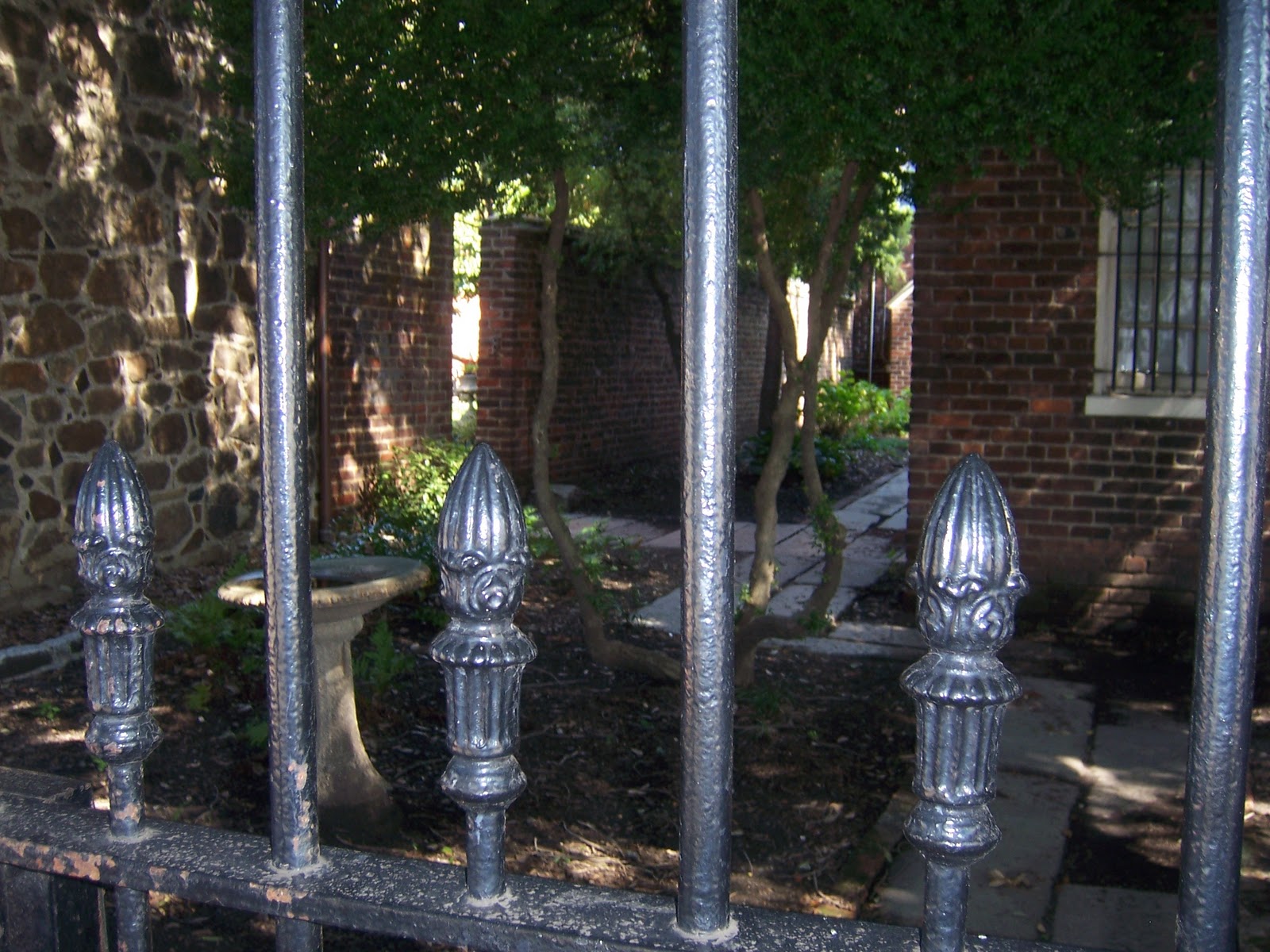
The inner courtyard of Richmond's Poe Museum, dated 1737 
Every time I walk into an old house with creaky floorboards I think of the old man’s beating heart . . . you fancy me mad?  No! It is the author of that story who is mad – Edgar Allan Poe! I say this only because of his story, “The Tell Tale Heart,” which I read when I was a mere child of 10 or 11 years old . . .

Little did I know that one day I would live in the city where Edgar Allan Poe grew up and wrote his first poems and stories. Perhaps he had entered this same building which I now entered, an old stone and brick structure with – yes, I say! – creaky floorboards!  It is the oldest standing building in Richmond, VA, built in 1737, now cramped and stowed away (like the old man's body!) on a busy street in the city’s downtown business district.  This unassuming building, now called the Poe Museum, keeps forevermore the artifacts of Edgar Allan Poe’s life . . . and death.

Poe never actually lived in the old building, but “he probably walked by here a lot,” our tour guide told us. My daughter and I came here on a beautiful sunny day to learn of Poe’s life in Richmond and to witness the just-opened special exhibit, “The Raven, Terror and Death.”

It is downright criminal that I and many other school children grew up thinking that this scary author haled from New England.  He may have been born in Massachusetts (he was), but his transient theatre parents moved to Richmond when he was only two years old. Baltimore takes an unwarranted claim on Poe’s life as well, only because Poe lived there for a paltry three years in adulthood after he married his 13-year-old cousin.  Also, Poe happened to die there on October 7, 1849 – that is, 162 years ago today! – under very dubious circumstances while en route from Richmond to Pennsylvania.  More on this later . . .

 
But the only rightful claimant to this author is Richmond, VA, I say!  Though rarely mentioned in biographies (and that’s a mystery to me), Poe grew up in Richmond and lived a good portion of his adult life here too.  Unfortunately, the houses where Poe lived in Richmond have all been demolished . . .

Nevertheless, this city provided all the elements of a grim foundation for Poe’s future instincts in storytelling.  His father promptly abandoned the family once they had moved to Richmond.  His mother died of consumption a year later. The three Poe children were parceled out to various families, one in Baltimore and two in Richmond.  Young Edgar was taken in, though never formally adopted, by the wealthy Allan family of Richmond.  The Allan’s wealth came from tobacco and slaves, as did all Virginia wealth back then.  Thus, he became Edgar Allan Poe.

Though he grew up in wealthy surroundings, he was never to experience the independence of wealth.  John Allan seemingly hated the young Edgar . . . and his wife Francis, though loving, died from consumption when he was still a boy.  Allan sent Edgar to the University of Virginia, but withheld tuition once he got there.  And Poe was soon expelled for drinking and gambling . . .

Back in Richmond, penniless, he came up with the idea of creating a literary journal in which his own stories and poems would be featured.  He charged $5 per issue, which in the early 1800s must have been as outlandish as the stories he wrote.  The office where he wrote and edited this literary journal still stands in downtown Richmond, but is now called “Rouge Gentlemen’s Club” – and it has nothing to do with literary concerns, or even gentlemen, one might say. 

This bust of Poe was stolen and taken to imbibe a few . . .
 There is a bust of Poe in the courtyard of the Poe Museum, which our tour guide said was stolen one night by a person who proceeded to take it to the Rouge Gentlemen’s Club where said-thief bought the marble bust a few drinks, then left it on the bar stool to fend for itself.  An honest bar attendant returned it to the Poe Museum a few weeks later with no hard feelings on either side. This is the kind of tidbit you can only pick up from a guided tour in which you and your daughter are the only two people in attendance.

But I’m getting ahead of myself. Since we had an hour “to kill” before our tour actually started, my daughter and I went over to nearby Shockoe Hill cemetery where many people in Poe’s life and literary career are buried.

The gravesite of Poe's beloved Jane Stanard, or "Helen"
Jane Stanard is a woman whom Poe loved dearly, though Jane was married and much older than Poe. He was only a teen when she died, and it is said he would visit the grave to weep and wail upon her gravestone.  His poem, “To Helen,” is famously written for her.  They say he changed her name to Helen because “Jane” had little rhythmic value to the budding poet.  In compassion for him, I draped my own body across Jane’s gravestone to feel the cold jutting rock on my cheek just as Poe must have felt it.  I tried not to disturb the wilted red rose someone had placed there.

Across the walkway from Jane, rest Poe’s foster parents, John and Francis Allan.  I imagine Poe coming here to spit (or worse) upon the gravesite of John Allan who ruthlessly left all his wealth to his numerous illegitimate children and not one penny to the poverty-stricken Edgar.

Farther down the way lay the remains of the woman to whom he was engaged twice – Sarah Elmira Royster.  Her wealthy Richmond family did everything in their power to break off the engagement, such as intercepting letters between them while he was in the army, and convincing their daughter he had abandoned her and that she should marry an upstanding Richmonder by the last name of Shelton.  Poe agonized to learn of her marriage to Shelton when he returned to Richmond to marry her.  Many of his poems and short stories include the names Elmira, Lenora, Eleanor, even Annabel Lee – and these are all in tribute to his love, Sarah Elmira.

Our tour guide said there might have been a happy ending to this love affair because the two were engaged a second time about 20 years later, after Sarah Elmira’s husband died.  Her family remained in opposition to the marriage.  That’s when great mystery begins – for Poe died unexpectedly in Baltimore only 10 days before the marriage date. He was found wearing someone else’s clothes and lying face down in a gutter in mental delirium.  He was 40 years old. The word he kept repeating was Reynolds, Reynolds, Reynolds . . . and this is another famous family name in Richmond – think Reynolds Aluminum . . .

The grim mustachioed Poe
Only seven people came to Poe’s funeral, most of those hospital personnel who were needed to carry the casket.  His betrothed was not among them.  Our tour guide told us there are about 30 theories as to how Poe died in Baltimore – everything from rabies to murder.  One of those theories inculcates the brothers of his beloved Sarah Elmira, who may have followed Poe to Baltimore and drugged him.  A movie is coming out in 2012, starring John Cusack as Poe, which will catalog Poe’s life and the many unsolved theories of his death.  I hope John Cusack is not sporting a mustache because our tour guide told us that Poe rarely wore one.  The iconic mustachioed photo of Poe which we all recognize, of which the original is in the Poe Museum, was taken four days after an attempted suicide – and the grimness of it bears little resemblance to his other photos in which he was clean shaven and somewhat “brighter.” Our tour guide explained that this grim photo became famous because Poe’s decrepit sister, who also lived in Richmond, had numerous copies made and forged his signature on each one for sale after his death!

The morning after our tour of the Poe Museum and visit to Shockoe Hill cemetery, I read in our local newspaper that a body with a garbage bag taped over its head had been found in a warehouse just outside the cemetery where my daughter and I had traipsed through the centuries-old knotted pathways looking for traces of the life of Edgar Allan Poe.  Hideous!  as Poe would say.  I sat at my kitchen table pondering such mysteries . . .

Thursday, September 8, 2011

Holy Cards

I’ve been looking over an old book of mine, Nonviolent Communication, a Language of Life, which is about how to listen and respond to people without offending them. The big problem with reading this book is the awareness it brings of how important it is to the health of body, mind and spirit to be heard fully and completely and to grant others the same gift – and how rarely that actually happens . . .

Most of us, when we hear a person’s lamentations, we want to dole out advice and solutions like pellets from a shotgun – Shut up, already! we seem to be saying.  That’s violent, according to this book.  Most often, people are seeking empathy and genuine understanding, not advice.  The book states that one of the best things a listener can do is to paraphrase or summarize what the other person has just said – that shows you heard them.

That’s one thing my mother could do well, listen – and on this third anniversary of her death I feel gratitude that I had such an experience as a teenager and beyond – one person who could listen well and not give advice.  I think I heard her say once that she wasn’t smart enough to come up with solutions and advice for other people’s problems. Little did she know that that is exactly the key to being a good listener.  She couldn’t solve anyone’s problems and she didn’t presuppose to try. So she just let them talk – usually while she went about the task of making dinner or canning tomatoes or washing dishes. Then again, maybe she wasn’t really listening at all!

I was surprised to learn, after I was married and had children of my own, that several of my high school friends still made the pilgrimage up the steep hill where we lived in order to “chit-chat” with my mother. She would casually inform me of their visits and of what they were doing in life, and I often wondered why they kept in touch with her but had lost touch with me! At her funeral, one of these old friends said to me, “I’m really going to miss our little talks – with your mother, I mean. She was a good listener.”

When my children were young and I was so busy with the never ending chores of motherhood, which of course left no time for writing, I would make a monthly-or-so phone call to my mother to unburden myself. I knew she understood the frustrations of a thwarted creative impulse because I had witnessed (and heard) her own struggles to pursue creativity in bits and pieces amid the chores of daily life. A few days later I’d get a letter in the mail – not crammed full of advice, but rather in brief acknowledgment of what I’d already said via phone. Then she’d go on to other things about the house or her church or her garden . . .

St. Francis de Sales, patron saint of writers 
Included in that letter would be a holy card of some designation – St. Jude was a favorite one she frequently sent, for he is the patron saint of lost causes. My family used to laugh about that. But there were other cards she’d send too, perhaps an archangel – Raphael, Michael, or Gabriel – to watch over me and guide me in the ways she did not presuppose to do.  I never knew why she sent me the card of St. Francis de Sales – until recently, when I looked it up. He is the patron saint of writers -- and he is known for his ability to "communicate with gentleness." 

I would put the “holy card of the month” on the refrigerator with a magnet – to remind me that someone had heard me – and that was a good solution.

Wednesday, August 31, 2011

Ode to Pesto, 1982

(Writing this at the library which just re-opened today, post hurricane) 

This is the fifth day of no power since Hurricane Irene – and while my losses are minimal and replaceable, and I'm grateful for that, I have to say I grieve the loss of my homemade pesto in the freezer more than any of my inconveniences. Basil, its main ingredient, is one of the few things I can grow without the squirrels eating it before harvest time – or before I awake in the morning. This year I went all out – I bought an extra special Romano cheese from Whole Foods Grocery at a price I don’t want to mention – it had just been cut at a Saturday morning "wheel cutting ceremony" of which there was much to-do. I bought organic pine nuts that were similarly priced – maybe more, I think. I always buy good Italian olive oil, so of course I bought more of the same. I found purple garlic which I remembered from my youth because my father used to grow it. I don’t know if purple garlic is better, but it was pricier and there was much nostalgia in buying it anyway. Those are the only five ingredients that make pesto – fresh basil, Romano cheese, garlic, pine nuts, and olive oil – but the dishes that can be made with that simple concoction are endless. 

My pesto recipe dates back to an old Bon Appetite magazine from June 1982, several years before my children were born or even considered – but the means and ways to use it have spawned with each passing year.  I’ve never skipped a year of making and storing pesto since 1982.  I assess that this year’s yield was the best I’ve ever made. 

Pesto pasta, pesto potatoes, minestrone with a dollop of pesto stirred in, pesto-baked salmon, pesto-grilled-everything, and of course pesto butter on homemade sourdough bread – these are some of the foods of which there was never any dissent among my family members at any age from toddlerhood-on-up. We all agreed for just those nights when pesto adorned dinner.

I wanted my pesto to be extra tasty this year for those times when my grown children would come home from faraway places. I wanted the memory of "home-in-agreeability" to reign for them. And I wanted enough of it to serve at all occasions – Thanksgiving, Christmas, random weekends, and all birthdays straight through to St. Patty’s Day when the next seedlings are planted. And so I even bought more basil at the farmers’ market when my own plants had exhausted themselves – more basil to make more pesto.

Now every bit of it, all my neatly stacked containers, rot in the warm dark freezer. The kitchen smells acrid and garlicky when I walk into it. I can’t bring myself to open the freezer door and throw it away yet – though it had thawed entirely two days ago. I’ve crossed the threshold of caring whether the power comes on today – my losses are tallied.

I’m not talking about the price of ingredients, a mere number that follows a dollar sign – that’s not what I tally or grieve. That’s not the value I assign to homemade pesto.  And I realize there are things far more valuable that I have not lost.  But I still think about the extra special effort I put into it this year – early morning treks to obtain quality ingredients – and all for the promise of another season when everyone might come together and agree. Pesto is the taste of agreement.  I wonder if the likes of Irene can understand that.

A woman’s heart is crazy and secretive that way – she’ll do so much and spend too much to implant a thing of value in the subconscious storehouse of memory for those who will never witness the effort or know about it or maybe even care about it . . . only, strangely, sense it by tasting . . . 

The 1982 Recipe:
2 cups packed fresh basil leaves
2 large garlic cloves
½ cup pine nuts
¾ cup freshly grated Romano or Parmesan cheese
2/3 cup olive oil

Grind it all up together in whatever way you choose – mortar and pestle, or blender.  And no, Irene, it's not the same as store-bought.

Monday, August 15, 2011

Strolling a` la Anne Spencer

I receive one poem per day via email from http://www.poets.org/ – which is nice because it’s just one poem, and it’s usually one which I would not come upon through my own devices. Yesterday’s offering was one by Anne Spencer, a contemporary of Langston Hughes and a member of the Harlem Renaissance School of Writers.  She died in 1975.  The poem is called “At the Carnival.”
Poet Anne Spencer's home in Lynchburg, VA
As I read it, I fondly recalled the day a few years ago when I strolled in front of Anne Spencer’s historic landmark home in Lynchburg, VA, and knocked determinedly on the front door to see if a tour was available – then sat on her porch, talked to her neighbors and some gardeners, took a few photos, and . . . finally, left. I happened to be in Lynchburg visiting my daughter who attended college there until her graduation in 2008.

I love going to writers’ homes and taking tours – feeling that certain feeling.  That’s what I like – feeling that certain feeling. Anne Spencer loved gardening, as do many writers.  She even had a little garden house out in the back where she would write.  I imagine she would write for a while, stroll through her rosebushes and do a little pruning work, then go edit some words out, then stroll and prune some more, rewrite . . . that sort of thing.  There were some men working in her back yard the day we were there.  I suppose they had been hired by the historic society to maintain the grounds as Anne Spencer would have liked them.  But they acted as though they had never even heard of Anne Spencer – this was just another job for them, and they were eager to be done.

My daughter was embarrassed of me that day, feeling I had pushed the envelope too far by sitting on Anne Spencer’s porch and talking to gardeners in her back yard. She sat in the car and waited for me impatiently as I strolled the neighborhood looking for someone who knew something about the Anne Spencer home and whether a tour was available.

We finally left the neighborhood and went to an historic cemetery nearby. We walked through a good portion of the cemetery’s 20,000 plots looking for Anne Spencer’s gravesite, but never found it. I later learned she was buried in a newer cemetery a few miles from there. We did learn all about African burial practices, however, and I took a few pictures of the gravesite of the most famous whores in Lynchburg, a mother-daughter team named Agnes and Lizzie Langley. They ran what was called “a sporting house” in Lynchburg during the Civil War era. They say it is uncertain as to whether the Langleys bought the elaborate grave marker with their own money or if their patrons bought it for them:
RIP, Agnes and Lizzie Langley, circa late 1800's
Then we ate some Indian food, perused a used bookstore where I couldn’t find any books by Anne Spencer but found a few other gems, and then drove to Poplar Forest which was Thomas Jefferson’s little-known summer retreat house nestled amongst 5,500 acres of . . . poplar trees. Poplar Forest is a bona fide tourist destination now, but in 2008 it was still in the process of being restored to its architectural authenticity, and we were privilegd and free to wander the house and gardens to observe the restoration in process. Jefferson said he went there "to be a hermit and to read and to entertain his absent friends." 
Thomas Jefferson's silent retreat called Poplar Forest
 Reading “At the Carnival” made me recall the spirit of that day – searching, strolling with my daughter, having fun, eating, finding things we didn’t look for, and not finding things we did look for. It was a carnival of sorts . . . and here are some lines taken from the center part of Spencer's long poem:

 I came incuriously—
Set on no diversion save that my mind
Might safely nurse its brood of misdeeds
In the presence of a blind crowd.

Wednesday, July 20, 2011

Starry Starry Plans

Driving home from my son’s college graduation last May, we decided to bail ship from the truck infested interstate to take the older and less traveled road, known as Highway 11, which traverses Virginia from east to west, and continues into Tennessee.

Driving through the gentle and open-armed Shenandoah Valley, we stopped at a small country store because of the sign’s promise of hoop cheese and real ham biscuits. There was some minor construction going on at one end of the store – actually, it was ‘de-construction’ of a sort – the old man who owned the store explained that he had decided to pull off the siding which he put up in the 1950s to ‘modernize’ the store by covering up the original log cabin architecture which dated to the mid-1800’s.  The store had been in the family that long . . .

He didn’t talk about a son or grandson or anyone else taking over the store in the future; he worked alone along the quiet highway with his hoop cheeses and real sorghum molasses, his jars of everything that could be pickled or canned by the nearby Amish women, his bushel baskets of seasonal produce the earth brought forth from nearby Fancy Hill, VA., and his tables full of smoked hams. His pink aged face was alive with plans for the ‘re-modernization’ of his family store – back to the old log cabin work of his ancestors . . . still full of plans.  He said something like that as he cut a wedge of hoop cheese for me, “As long as I’ve still got plans, I figure I’ll never get old.”

All the while he talked, I looked at the table of hams behind me, the hoop cheeses in the background. What voice inside me whispered, starry night?  Suddenly I saw Van Gogh’s famous painting in a table full of hams and hoop cheeses – but the painting had turned pink and red and cheddar instead of blue and green and summery.  If I were a painter – and I wish I were, for there are times when words are tiresome and harsh – I would get out my palette of pinks and lavender-reds and browns, moss greens and silver-greys. . . and I’d paint a table full of swirling hams and call it “Starry Starry Plans.”

August, my least favorite month of the year, is just around the bend.  My own writing plans are on hold until September . . . and my son works long into the night on his plans for a stellar future . . .