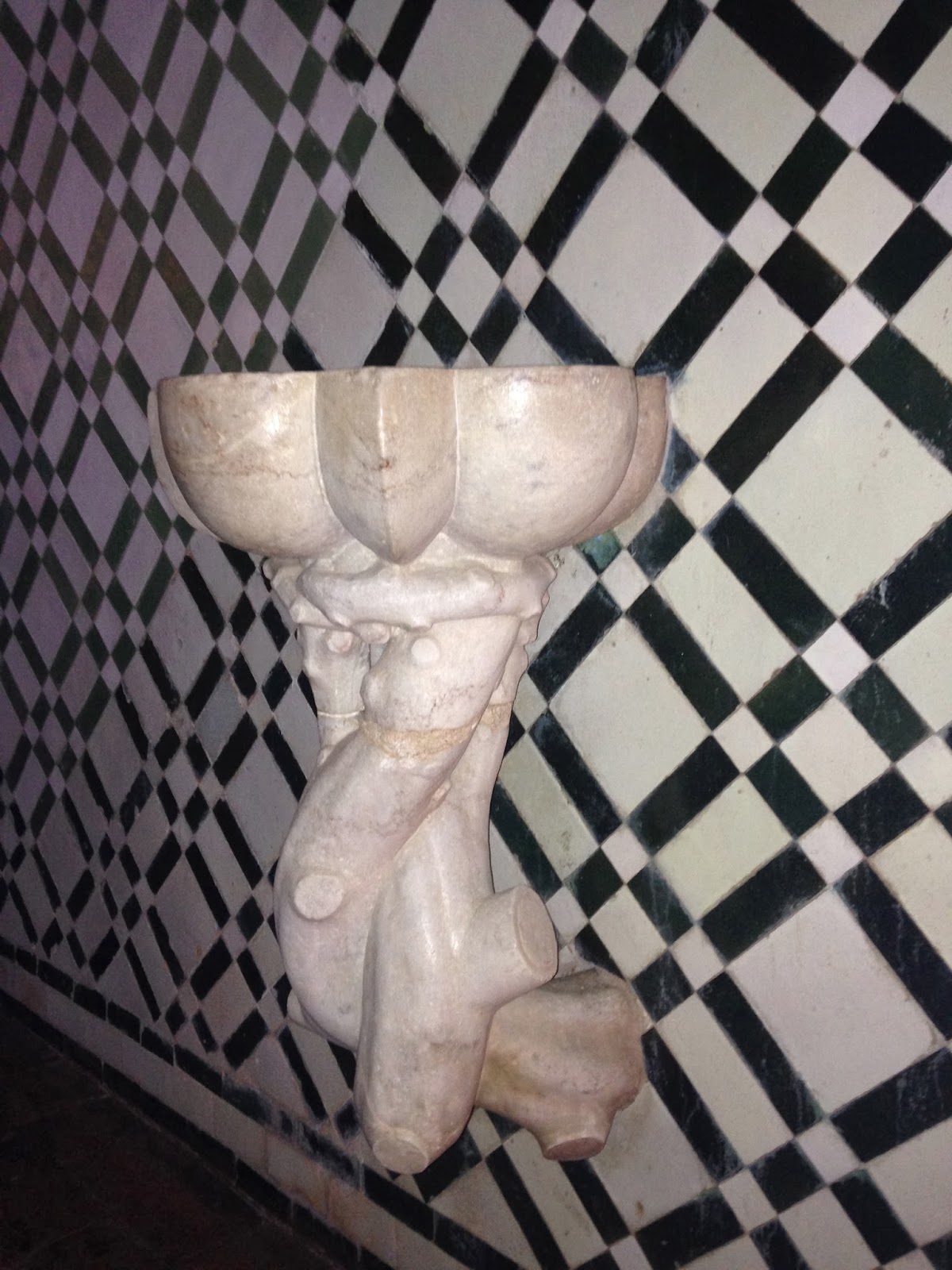
Thursday, March 20, 2014

Speckles

Inspired by a quote from Gary Snyder’s book, “The Practice of the Wild”


Back when I had time to write only
poems, I’d spend the speckled parts of
one day reading the thing that was penned
by inspiration in the shower – changing
a word or letter or comma, here or there – till
the thing was quite fixed over by day’s end, and it was

all done in those flecks of time, for I had all
the daily vacuuming to do, the black and white
kitchen tiles to mop – and many full meals –
and much washing and bed making too, for

nothing was short changed or skipped – and  
yet I wrote the poems – about housewifery, most
of all, for that was my vantage, and the seeing of
speckles and dapples and shine even when
the dull tedium added up to nothing, everyone knows

housework has that reputation, must be
shined and polished daily, and even then, it’s at
best a pot or pan, window, mirror – face it . . .
to most.  I’ve never had the authority
to call it more or make it sound
like a way to polish one’s life, or to live in the
present moment, or to say it was the
“highest calling of my 24 hours,”

which I read in a book the other day – the highest calling
of the 24 hours, and so I laughed to think that   
herding children into a carpool van, or shifting numbers in
major business plans, or directing people in the role of
boss or dictator – that it’s all the same, the most important
work of the hour, he said. 

I have struggled to think the same, make myself feel
more than I was, all in the practice of making dull shine;
I have made the black squares blacker
and the white squares . . . whiter.  It’s the practice of the
kitchen floor shine, albeit bent over, and
knowing dullness and routine and the hour.

It is not lofty work, not even to me, the one writing
this poem at the hour – and I have no authority
to make it sound so, not from this inner vantage, still bent
over this or that – it is a practice, to stay alert,
a path of sorts, to walk or skip or drag the feet
along black and white kitchen tiles – everyday, the hours . . .

in spite of dingy
windows and carpets and walls – days when
everything is cast as shadow and blur – always the practice of
finding speckles and sparkles to keep one stepping,
one more day, another chance
to practice it, to get it right, to make the
black tiles blacker, a comma act brighter, or white tiles  
whiter.


Monday, March 10, 2014

Fully Workable Hands

Coming home for breaks from college in the 70s, I would sometimes ride with a young man from a neighboring small town.  I knew he liked me-liked me, and I felt so uncomfortable with him that I often, I’m sure, said nothing at all on the six-hour drive home, except to answer his endless questions as succinctly as possible so as not to encourage him.  I knew he was searching for a date with me because of the types of questions he asked, such as, “What do you do for fun?” and “Do you like movies?” and “What kind of music do you listen to?” and “Do you like to dance?”  There were other signs too, of which young girls are acutely aware. 

I don’t remember his first name, but I remember his last name started with a G, because at one point he said, “We have that in common, both our last names start with G!”  That made me laugh.  G was friendly and outgoing and smart, and he is what people called back then a “thalidomide baby.”  He had very short arms that stopped somewhere up around the biceps, and small hardworking hands that emerged from the short-sleeved shirts that he always wore.  His chest was folded forward and his upper back was stooped from a lifetime (19 or 20 years) of having to function with arms that never reached a school desk, or a tabletop on which his fork and plate were placed, or, in this case, the steering wheel.  As he drove, his chest was nearly lying upon the steering wheel and his chin was touching the top of it, while his hands grasped each side at 10 and 2 as we’d been taught to drive back then.

He showed no self-consciousness of his condition; this was simply the way he knew his own life – just as I am accustomed to arms my own length with the relative “handicap” of not being able to reach across the room.  But I was young and extremely self-conscious at the time, and I tried always to avoid looking at him in the driver’s seat as he talked endlessly and asked questions to draw me into the whirlwind that he seemed to create with his hands as he drove and gestured.  I’ve always known better than to say this, but G’s hands were disturbing to me, poking out of his short sleeves as they did, like heavy wings that were trying to fly away.  They were small and somewhat deformed, and they worked so fast and independently of the rest of his body, that it seemed like two additional people were there in the car talking to me.  His hands did all the work of pointing and waving and gesturing and alternately steering the wheel.  Once he asked me what kind of car I liked.  I had no knowledge of cars back then, and no anticipation of owning a car, and no opinion about cars – but he kept pointing at cars, every one that passed us, lifting his hands and pointing and calling out the make and model and even the year, until finally I said, “I like that one.”  It was a Karmen Ghia, he told me, and that kept him silent for one minute.  Many years later when I owned my first car, that is the car I owned.  G was that kind of person, always working hard to engage the world around him – a whirlwind – and I suppose he influenced many people with that manner of his.               

But I was the person that I was, very introspective, self-conscious, and content to be quiet.  With G or not, I would much rather have looked out the window for six hours, thinking about the books we had been reading in literature classes I was taking – or any number of things I liked.  My favorite author at that time was Sherwood Anderson, and my favorite book of his was a collection of interconnected stories about the characters in a small town, called Winesburg, Ohio – and my favorite story in that collection was called “Hands.”  It’s about a man named Wings Biddlebaum whose hands are always nervously fiddling about as he talks.  In hindsight, I don’t know if I noticed G’s hardworking hands because of that being my favorite story, or if “Hands” became my favorite story because of noticing G’s hardworking hands.  It was all related.

G was studying pharmacy at UNC where we both attended, and he would one day take over his father’s drug store business in the small town near mine – that was his plan.  His father had provided his mother the thalidomide when she was pregnant with him – my mother told me this, for people in small towns, even neighboring ones, know these things – for her nausea, and of course no one knew at the time what the effects would be.  My mother said this one time after G dropped me off at our house and politely came inside to greet my mother and to shake my father’s hand. 

Thursday, February 13, 2014

One Red Button

The place for supplies 
Funny, we all think, how on a pre-snow day the grocery stores always empty out of essential foods – but, to be in JoAnn Fabrics and Crafts, as big and well-stocked as any grocery store, and to see the women there in throngs, buying 12 yards of interlining; or 7 yards of interfacing; or one yard each of 12 patterned fabrics; or enough black and white thread to last till the end of time . . . that is funny.  One woman, her cart full of supplies, said, “Now I’m ready for the snow day tomorrow – watch it not get here!”  She laughed, as did other women nearby who were most likely thinking the same thing and similarly gathering supplies for the arrival of snow.     

I had gone there to get one big red button and some cording for a small project of my own.  I have only recently put my hand to sewing after a 30-year hiatus, and I find it to be much like bread baking in the way it can jog one part of the brain in order to open up the other part of the brain that often gets stuck in non-writing mode.  As I stitch, words fall into place, order becomes apparent, and a pattern emerges!  Anyway . . .

Like in a candy store . . . 
I stood in line nearly 30 minutes for my $12 purchase.  These are not the same faces I saw in the grocery store earlier today, I thought.  No one here was complaining about the long lines or the lack of supplies on the shelves or the understaffed store. These women were happy to have obtained their goods for an anticipated play day.

The woman in front of me looked back at my few meager items which I held in my left hand (other women had carts, real grocery carts, full of sequins and glue and threads and bolts of fabrics and rolls of batting and such) – she looked back at me and said, “Got a coo-pon?”  She might have said, “Got Milk?” as on that television ad – so firmly and surely did she say it to me.

I looked down at the one red button and three one-yard-length cords I held, and said, “No.”  I realized I was the only woman in line without a grocery cart or booklet full of coo-pons.  She didn’t say anything, just proceeded to scroll at her smart phone, then turned back, handed me a paper coo-pon for 40% off one item, and said, “I’ve got this one on my phone, so you can have it . . .”   I was very grateful, calculating I’d use it for the pricey $5 button I held, and that it  would save me $2 or so.  She inched forward in line, saying, “Ever’ little bit helps, right?”

In the parking lot, one woman loaded her car with a cart full of fabrics and supplies – all in her trunk. She looked up as I squeezed by, and gave me some kind of “knowing smile” – it was a little sheepish too, as though admitting the trick of putting bags in the trunk in order to hide it from one's husband.  I’m not sure if that’s what the sheepish smile meant, but I smiled back in a knowing fashion and nodded to her, just as I had gratefully accepted the coo-pon from the other woman.


I needed one perfectly red button
I put my button and cords in the car, and suddenly thought that chocolate chip cookies would be fun to bake on a snowy day, and so I walked up the sidewalk to a grocery store.  I passed by a liquor store on the way and saw throngs of men inside, standing in lines equally long as at the crafts store.  I hovered nearby, pretending to read signs in the window, all the while noting the men walking in with hands in their pockets and heads to the ground, not browsing in the store but going directly to the aisle of their intention – and men walking out, holding a black plastic bag in each arm, heads still down.  There were no bonds or “knowing smiles” amongst them – and I wondered if one of them might open the trunk of his car to find a cache of hidden craft supplies . . . 


Thursday, December 19, 2013

Breakfast at Fontecruz, Lisboa


Puny silver-haired Frenchman and
his underage Anthropologie-clad
mistress -- all her decades of lace and old-fashioned
frill, his brown checkered pants
cinched at the waist
by a belt pulled too tight, complaining
in high-pitched French tones, there's no
eggs at the buffet!  then

smiling beside himself at her
seated glance of approval while
the Lisboan scrambles
for his, the sound of one, two, three wet
smooch, making himself

an escargot of it all.

Sunday, November 24, 2013

Walking into Walls

Strolling along the beautiful patterned walkways of Lisbon, one eventually comes to a wall -- that is, tile walls -- for which the Portuguese are known worldwide.

Tile making, or azulejos, probably comes from the Arabic word azure which means 'smooth surface.'  It's hard to put a date on when the Portuguese became the most renowned tile makers in the world because azulejos came to Portugal via Moorish influence (dominance) well over 1,000 years ago -- and Spanish influence (dominance) about 500 years ago.


Both cultures contributed a diverse style of tile making, which was really, in its primitive state, just "wall making" -- designed to keep out rebellious subjects.  I stood for a long time at this crude Moorish wall that surrounds what is now called St. George's Castle, built on the highest peak in Lisbon by the conquering Moors around 800 A.D.   Today it is a popular lookout post for lackadaisical peacocks.  Some areas of the fortress date to the 4th century.


Moorish design is characterized by geometrical patterns and extensive symmetry. Early examples were devoid of color because the technique for using color was not devised until the late 1500s.


The technique for color, called maiolica, came to Portugal through Spain -- and to Spain through Mesopotamia in the 9th century -- and to Mesopotamia from China. Color led to an outpouring of patterns and creativity . . .


Blue and white is considered to come from the influence of Chinese ceramics, brought back to Portugal through India after Vasco da Gama famously discovered the trade route to India and Asia in the late 1400s.


The most humble of restaurants and pastry shops is graced with tile wall patterns, both inside and outside.  This is the exterior wall of a tiny restaurant called "Istanbul Pizza Shop."


This exterior wall graces one restaurant on a tiny island in the Tagus River, the longest river on the Iberian Peninsula.  It runs east to west through Spain, and empties into the Atlantic Ocean off the coast of Lisbon.  As we sat outside and ate salted dried codfish and drank vinho verde wine,  I wondered what significance those petite floral patterns held -- because, as I came to learn, virtually everything in Portugal carries symbolic significance.   The interior walls were just as beautiful as the exterior.

No place shows the diverse styles of tile making more than at Pena Palace, which is located about 45 miles from Lisbon.  This was the summer palace for the Royal Court through 1,000 years of history and changing regimes -- beginning of course with the Moors in medieval times, and ending with the rein of Don Manuel II in 1910.  Each regime, or conquerer,  preserved the existing artistry of the palace, but added its own "updated" style -- therefore it is a panoply of architectural and tile making history.

Legend is just as important (and real) to the Portuguese as documented history.  We were told by a native Lisboan that "if it happened in Portugal, there is a legend for it."  And if there is a legend for it, she added, there is probably something built to commemorate it . . . to honor it . . .
Tile making is one very useful mode of expression to catalogue the nation's identity. Symbolic representations of the country's folklore, legends, heroes, and history are literally spread out on the walls for citizens to absorb daily.  Perhaps history books for young children are optional!


I was strangely drawn to a circular pattern with a knot in the center, which I later learned is called arbiter esfera, or the armillary sphere.  It is a symbol of the constellations, but representative of the nation's great seafaring history.  In its glory days, beginning in the late 1400s when Vasco da Gama discovered the trade route to India, Portugal dominated the Indian Ocean and therefore economic trade for well over a century.

I could not bring home a wall of tiles, or even take pictures of all the walls I loved, but I settled for three beautiful tiles which caught my eye (and would not let me go home without them). I found them in an antique store just down the steep hill from the old Moorish castle that overlooks modern day Lisbon. They date to 1750, which means they were crafted before the catastrophic 9.0 earthquake of 1755 which devastated the nation and left it in ruins for nearly a century.  

The antique dealer from whom I bought these tiles noted that he had never seen a pattern such as the third one shows -- "not even in tile museums," he said.  As I contemplate that third tile from my seat at the kitchen table at home, I surmise that it may have been the singular experiment of a woman who was not really a tile maker by trade -- perhaps her husband or father or brother was a tile maker -- and perhaps she had an idea for a trellis type design which she had got from observing the way vines grow along a fence outside her kitchen window or along the tiled walkway on her way to market -- and maybe her father or brother or husband said it was not such a good design because it had never been done before -- and so she stopped making tiles after that first one -- but somehow this tile survived the catastrophic earthquake of 1755 -- though maybe she did not -- and maybe she had a bit of Moorish or Arabic blood in her from long ago -- because, when I sit back and look at this tile long enough, those vines begin to look like Arabic writing . . .

Wednesday, October 30, 2013

Walkabout Lisbon


The sidewalks -- that is the first thing I noticed when I stepped out of the hotel lobby onto Avenida Liberdade in Lisbon, Portugal -- the beautiful mosaic patterned sidewalks.  On that first day of walking through Lisbon I think I did not even lift my eyes to look at the numerous monuments and cathedrals, Moorish castles, or perpetual blue skies that graced our weeklong visit -- because the limestone sidewalks were so beautiful.  And the more we walked, the more varied and interesting the sidewalks became . . .


Most of the city's sidewalks were made by prisoners in the early 1800s.  It was thought that the prisoners needed something to do with their time, and that the "something" ought to benefit the nation.  Therefore, they were put to work creating much-needed walkways for a city that had been devastated nearly to extinction by a 9.0 earthquake and tsunami on November 1, 1755.  It is a day still talked about by Lisboans -- their history, their art, and even items for sale in antique stores, are categorized as "before the earthquake" or "after the earthquake."  I bought three beautiful tiles from "before the earthquake," that is, from 1750 -- "survivors," the store owner called them.  


The Marquis of Pombal, the Secretary of State during the reign of Joseph I in the late 18th century, is much honored and credited with foreseeing the benefit of a "grid pattern" in rebuilding Lisbon after the earthquake. Nothing was left to the city but rubble and mud at that time, and so anything could have replaced it.  The previous layout of Lisbon, like all medieval cities, had been designed on a circular pattern in which the city radiated out from a commercial "center" (from which our word city is derived).  


At the time, The Marquis was criticized (or at least questioned) for making the sidewalks so wide.  His response was, they may seem wide now, but someday they will be filled with people.  Many monuments exist throughout the city to pay homage to this man with such foresight, but I admit I did not take a single picture of his monuments -- simply because I was taken up by the handiwork of his position, not by the man himself.  Is this not the mark of a true leader?


The "Alfama" district of Lisbon was miraculously saved from total destruction during the 1755 earthquake.  Therefore, the medieval winding walkways still exist.  This is an area built primarily by the dreaded and overbearing Moors of the 9th and 10th centuries.  History is filled with accounts of Portuguese struggles (battles/wars) to overcome Moorish rule.  However, hated as the Moors were, their buildings -- and walkways -- were indestructible.  These 1,000-plus-year-old walkways are still trodden by the likes of me today.  One can spend a pleasant day tangled up in Alfama's winding streets while looking for Fado houses or family restaurants serving inexpensive lunchtime fare of salted dried codfish and local olives and pitchers of delicious Vinho Verde.  I will always remember those meals -- and those inclusive pitchers of wine -- and the winding narrow walkways that would miraculously lead us out of Alfama and onto the familiar grid-like streets.  


The walkways are made from a type of limestone, called "creme lioz," that is abundant in the nation.  Each small tile, as they are called, is chiseled by hand and made to fit into the ground about two or three inches deep; it is made smooth on top, and placed into patterns like puzzle pieces.  The tiles come primarily in two natural colors -- black and white -- though I have noticed (in the proximity of monasteries or cathedrals, at least) there is also a natural pink and a brownish-bronze.


The patterns, like so many things in Portugal, are designed with a purpose -- and that purpose is to pay homage and remembrance to an event in Portuguese history.  The above and below photos show homage to the nation's searfaring history, most especially to Vasco da Gama who discovered a trade route between Portugal and India in 1497, thus granting the Portuguese supremacy over the Indian Ocean throughout the next 100 years.


I think one of the most profound traits of the Portuguese people is their natural inclination to give thanks.  I noticed that people often greet each other by saying, Obrigado, or thankyou!  They are thankful for the many miracles on which their country's legends are based, for their rich history, for overcoming Moorish dominance, for strong family ties, for the bounty of fish which the Atlantic Ocean provides, and for the beauty all around them.


Even the dogs seem to pay homage to the city's sidewalks by mimicking its native colors.  I call this photo "Black and White." Only seconds after this photo was taken, the cute pup ventured to attack a white pit bull (unleashed) as it strolled by.


In a country deemed by economists to be one of the poorest in Europe, where unemployment staggers at 30 per cent, and where many educated men and women sleep on the sidewalks which I've shown -- there is art everywhere.  One young woman, Margarida, who works three jobs to make ends meet (one of which is to conduct weekend walking tours for English speaking tourists), said, "I wish I could be a tourist in my own city.  It is hard to make a living here, but it is beautiful!"