A short article buried in section/page B-5 of our local newspaper caught my attention to a greater degree than any newspaper editor might have imagined. This was news out of Philadelphia – stating that one of only seven executives to know all three parts of the secret to making Thomas’ English muffins is leaving his post to take a lesser-paying job with Hostess, maker of Wonder Bread and Twinkies.
This is not bread – the English muffin – it is a product defined and given signature by its presence of nooks and crannies – those empty places within the structure of toasted gluten where butter and jam might be cradled and crunched.
I know about the English muffin – which is to say I have not succeeded in producing these hallmark repositories for butter and jam. The unobtrusive English muffin seems to me the pinnacle of bread baker’s art – not even sourdoughs have daunted me as much, for at least the sourdough is glad to be alive and will tell me what it needs. But the English muffin is stalwart and guarded of its clues. I have all the equipment and many recipes that promise to yield the authentic result – but this persistent baker/writer has met her match. The English muffin is the place where smooth texture and consistent crumb are not the advents of success. As they say in many forms of martial arts or Eastern practices, the true Master leaves behind all rules. During my very brief teaching career, when challenged by students who wanted to know why they had to follow the “five paragraph rule” of writing an essay, I would say, “So you can throw it out once you’ve mastered it.” So it is with the English muffin – one must know the rules of bread baking so well that one can break them and thus produce a superior product. Paradoxically, the rules do apply – only they are no longer written rules – they are unspoken, as those seven masters at Thomas’ know. The secret is transferred via one great mind to another.
The company that makes Thomas’ English muffins has successfully protected their secret for more than 75 years. According to the article, there are three parts to the winning formulae – and this is more than I’ve heretofore known about the English muffin. Every recipe I have admits there is a secret, and then proceeds to tell you the secret: use of carbonated water in the dough, a bit of baking soda to the yeast, a bit of baking powder to the yeast, baking soda to the carbonated water, a pinch of pure ascorbic acid to the water . . . definitely no milk . . . and none of those secrets is the real thing.
The owners of the Thomas’ English muffin brand are suing back-stabber Chris Botticella because they say they have “good reason” to believe he will expose the secrets to Hostess who doesn’t make an English muffin at this time. Botticella says that his confidentiality agreement is valid “only during his employment” – and does not bar him from working elsewhere. But there are only four biggies in the English muffin industry – and this possible fifth could have major impacts on profits, makers of Thomas’ brand say. Plus, there are other secrets – for new products – which he knows. That said, I think "Bays" brand makes a far superior English muffin to Thomas’ – those Bays’ repositories will accommodate a swallow of good tea along with butter and jam.
The nook and cranny is really just empty space. This reminds me of the pinnacle of writing in which the most important words are really those that exist between the lines – open space for the reader to say for himself. I think of all those great writers of literature who have devoted their lives to lining the bookshelves of libraries for generations to come so that silent parties might walk the aisles with their own thoughts – and that aisle is a cranny.
Author John Gardner has said that the best writing leaves much un- said so that the reader has to come up with connections and conclusions that make him or her feel smarter than the writer. And when a reader feels smarter than the writer, it makes that reader want to sit down with the writer in order to share dialogue – sitting and talking together. The nook is an open space formed by two adjoining walls; a place larger, at least wider, than the cranny. It’s a place large enough for two people to sit and talk.
The hardest thing to put in writing is the thing you can’t put there at all. You have to create the structure – that is, glutenous strands – then provide temperature, time, and humidity – and a good dose of patience – till the reader sees between the lines.
Nooks and crannies must come of themselves, and in their own time – that’s what I’ve learned about writing – I mean, about English muffins . . .
Bread baking and writing go "hand in hand." What I learn from one, I gain in the other. Using my past experience of creating beautiful, delicious, yet healthful and uncompromised breads, I now set to the task of writing my first book. I say, "If I could make whole wheat rise . . . "
Monday, June 28, 2010
Tuesday, June 15, 2010
The Long and Short of it
While reading an article recently about the 10 best book stores in the nation, I wasn’t surprised to see these supersized descriptions – “20,000 square feet and more than 500,000 books;” “One entire city block and 650,000 used books;” “1.5 million books in stock;” “1 million volumes in 3 convenient locations.” My favorite description is the slogan from Strand Bookstore in NYC: “18 miles of books!”
My first memory of too many books to fathom comes from my student days at UNC-Chapel Hill where the Wilson Library famously housed 10 stories of books – five stories above ground and five underground. The collectible and rare books were housed underground, and I would often descend to the bottommost floor on a Sunday afternoon where I would stroll through the cramped, dark aisles, and smell the books. This was before the time of super security and hidden cameras – and so I truly felt alone with all those centuries of knowledge and my own private thoughts.
A more recent exper- ience came last year when my family and I went to the Library of Congress in Washington, D.C. for the 200th anniversary of Abraham Lincoln's birth. They say that a copy of every book that has ever been copyrighted is housed there and at various undisclosed sites in Maryland. The architecture and feeling of the building is worth the trip, but you can’t actually see all those books – nor can you check them out. But we must believe they are there.
At the other end of the spectrum, I can’t stop thinking about the tiny bookshop which opened about 18 months ago in the old auto repair shop on Main Street in my hometown in North Carolina – what might be considered one of the 10 smallest bookstores in the nation. I spent many-a-morning, a few weeks ago, perusing the “Local Literature” section which occupies about four feet of space on each of three shelves beside the checkout desk. I recognized many of the authors’ names – my high school English teacher, a guy who played football with my older brothers in high school, a woman who attended church with my mother, and a “stranger” who wrote a book about terrorist Eric Rudolph who was captured in a dumpster behind the local Sav-A-Lot store where my mother often shopped. There were other books about Cherokee Indian folklore and medicine, maps and guides for hiking the local trails, that sort of thing. But why two books about Abraham Lincoln?
“Those are because of Lincoln’s real father being buried here – you never heard that?” That came from Linda who is the bookstore owner and former schoolmate of my older brothers.
After a few questions to reorient my mind to – and against – everything I had learned in elementary school about Abraham Lincoln, Linda proceeded to explain that no local person ever believed that Abraham Lincoln was born in Kentucky. I was 10 years old when my family moved south from Upstate New York, so I guess that’s why I hadn’t been made privy to what everyone knew . . . and so Linda proceeded to tell me the “real story” of Abraham Lincoln:
His real father was Abraham Enloe, a wealthy Western North Carolina plantation owner. Our future President was born, not in Kentucky as the history books tell us, but illegitimately in Rutherford County of Western North Carolina. He was moved to Kentucky in a wagon when he was about one month old by his mother, Nancy Hanks, and a man named Thomas Lincoln who had been hired by the real father to marry her . . .
I'll back up. As legend goes, Mr. Abraham Enloe’s wife was visiting relatives in South Carolina when Nancy Hanks, a maidservant at the Enloe family estate, became pregnant. Upon her return, Mrs. Enloe promptly fired Nancy for being pregnant out of wedlock – she didn’t know who the father was – but then, once the baby was born, Nancy had the nerve to bring little Abraham Enloe Junior – yes, she named him that on the birth certificate – to the Enloe household to show him off. They say Mrs. Enloe took one look at the baby and went into a screaming fit because he looked just like all her other babies. Reportedly, Mr. Enloe gave a local kid, Thomas Lincoln, $500 in gold and a wagon to take Nancy and the baby to Kentucky and to marry her there. That’s how our future President came to be in Kentucky and came to be named Abraham Lincoln instead of Abraham Enloe. They say Mr. Enloe visited Kentucky – and Nancy – until Abe was six years old. That’s when Thomas Lincoln “found them together,” and decided to move his family to Indiana.
A man in Eastern North Carolina has written a persuasive and well documented book about the local legend that flies in the face of history: “Abraham Enloe of Western North Carolina.” Linda said the author, Don Norris, has come to her store for book signings on several occasions.
“I’ve got three signed copies at home. I’ll bring you one tomorrow,” she promised.
In the meantime, Linda gave me directions to the old gravesite where Lincoln’s supposed natural father is buried. But she warned me that the grave was marked “Abram” Enloe because people wrote things as they sounded back then – Abram.
This one Abraham Enloe had sired 16 children by his own wife – all tall and lanky like himself – and it is believed he has sired many others through the Carolinas and Georgia.
Linda told me that a man drove up from Atlanta last summer and went into the local Chamber of Commerce by the rail tracks and said he needed some help finding the gravesite of a possible relative of his. The woman in charge of the Chamber said to him, “And I know just where he’s buried” – and the man said, “How did you know?” And the woman replied, “Because you look like all the rest of the Enloes.” Linda said the man was tall, lanky, and dark featured.
Unlike today, no one during Abe’s lifetime would have written a book or tabloid article about such a “shameful” past. The locals of the time knew all about it, according to Linda – and that was shame enough. The Enloes were good people, and Enloe is still a good family name in the region; they were landowners and they employed a lot of people in Western North Carolina. No one would have been fool enough to bite the hand that feeds them. But everyone knew . . . and Mildred verified this.
Mildred was the 93-year old woman who walked into the book shop the next morning while I was there to pick up my signed copy of “Abraham Enloe of Western North Carolina” and to report on the gravesite I had visited. Mildred said her grandparents owned much land in the area and they also kept indentured servants. Oh, honey, everyone knew . . . and she shook my arm in earnest.
And I can’t stop thinking: There’s no bookstore in this nation big enough to hold the kind of thing that everyone knows . . .
My first memory of too many books to fathom comes from my student days at UNC-Chapel Hill where the Wilson Library famously housed 10 stories of books – five stories above ground and five underground. The collectible and rare books were housed underground, and I would often descend to the bottommost floor on a Sunday afternoon where I would stroll through the cramped, dark aisles, and smell the books. This was before the time of super security and hidden cameras – and so I truly felt alone with all those centuries of knowledge and my own private thoughts.
A more recent exper- ience came last year when my family and I went to the Library of Congress in Washington, D.C. for the 200th anniversary of Abraham Lincoln's birth. They say that a copy of every book that has ever been copyrighted is housed there and at various undisclosed sites in Maryland. The architecture and feeling of the building is worth the trip, but you can’t actually see all those books – nor can you check them out. But we must believe they are there.
At the other end of the spectrum, I can’t stop thinking about the tiny bookshop which opened about 18 months ago in the old auto repair shop on Main Street in my hometown in North Carolina – what might be considered one of the 10 smallest bookstores in the nation. I spent many-a-morning, a few weeks ago, perusing the “Local Literature” section which occupies about four feet of space on each of three shelves beside the checkout desk. I recognized many of the authors’ names – my high school English teacher, a guy who played football with my older brothers in high school, a woman who attended church with my mother, and a “stranger” who wrote a book about terrorist Eric Rudolph who was captured in a dumpster behind the local Sav-A-Lot store where my mother often shopped. There were other books about Cherokee Indian folklore and medicine, maps and guides for hiking the local trails, that sort of thing. But why two books about Abraham Lincoln?
“Those are because of Lincoln’s real father being buried here – you never heard that?” That came from Linda who is the bookstore owner and former schoolmate of my older brothers.
After a few questions to reorient my mind to – and against – everything I had learned in elementary school about Abraham Lincoln, Linda proceeded to explain that no local person ever believed that Abraham Lincoln was born in Kentucky. I was 10 years old when my family moved south from Upstate New York, so I guess that’s why I hadn’t been made privy to what everyone knew . . . and so Linda proceeded to tell me the “real story” of Abraham Lincoln:
His real father was Abraham Enloe, a wealthy Western North Carolina plantation owner. Our future President was born, not in Kentucky as the history books tell us, but illegitimately in Rutherford County of Western North Carolina. He was moved to Kentucky in a wagon when he was about one month old by his mother, Nancy Hanks, and a man named Thomas Lincoln who had been hired by the real father to marry her . . .
I'll back up. As legend goes, Mr. Abraham Enloe’s wife was visiting relatives in South Carolina when Nancy Hanks, a maidservant at the Enloe family estate, became pregnant. Upon her return, Mrs. Enloe promptly fired Nancy for being pregnant out of wedlock – she didn’t know who the father was – but then, once the baby was born, Nancy had the nerve to bring little Abraham Enloe Junior – yes, she named him that on the birth certificate – to the Enloe household to show him off. They say Mrs. Enloe took one look at the baby and went into a screaming fit because he looked just like all her other babies. Reportedly, Mr. Enloe gave a local kid, Thomas Lincoln, $500 in gold and a wagon to take Nancy and the baby to Kentucky and to marry her there. That’s how our future President came to be in Kentucky and came to be named Abraham Lincoln instead of Abraham Enloe. They say Mr. Enloe visited Kentucky – and Nancy – until Abe was six years old. That’s when Thomas Lincoln “found them together,” and decided to move his family to Indiana.
A man in Eastern North Carolina has written a persuasive and well documented book about the local legend that flies in the face of history: “Abraham Enloe of Western North Carolina.” Linda said the author, Don Norris, has come to her store for book signings on several occasions.
“I’ve got three signed copies at home. I’ll bring you one tomorrow,” she promised.
In the meantime, Linda gave me directions to the old gravesite where Lincoln’s supposed natural father is buried. But she warned me that the grave was marked “Abram” Enloe because people wrote things as they sounded back then – Abram.
This one Abraham Enloe had sired 16 children by his own wife – all tall and lanky like himself – and it is believed he has sired many others through the Carolinas and Georgia.
Linda told me that a man drove up from Atlanta last summer and went into the local Chamber of Commerce by the rail tracks and said he needed some help finding the gravesite of a possible relative of his. The woman in charge of the Chamber said to him, “And I know just where he’s buried” – and the man said, “How did you know?” And the woman replied, “Because you look like all the rest of the Enloes.” Linda said the man was tall, lanky, and dark featured.
Unlike today, no one during Abe’s lifetime would have written a book or tabloid article about such a “shameful” past. The locals of the time knew all about it, according to Linda – and that was shame enough. The Enloes were good people, and Enloe is still a good family name in the region; they were landowners and they employed a lot of people in Western North Carolina. No one would have been fool enough to bite the hand that feeds them. But everyone knew . . . and Mildred verified this.
Mildred was the 93-year old woman who walked into the book shop the next morning while I was there to pick up my signed copy of “Abraham Enloe of Western North Carolina” and to report on the gravesite I had visited. Mildred said her grandparents owned much land in the area and they also kept indentured servants. Oh, honey, everyone knew . . . and she shook my arm in earnest.
And I can’t stop thinking: There’s no bookstore in this nation big enough to hold the kind of thing that everyone knows . . .
Thursday, June 3, 2010
A Time for Prose
I read something noteworthy last night in the WWII-era travel memoir, Seven Years in Tibet – two starving, frostbitten, coinless, and tired men take a look at the splendorous beauty of the Forbidden City of Lhasa, Tibet which has taken them 18 months of death defying ordeals and prison escapes to reach – a vision and height which no European before them had ever attained – and one says to the other, “After poetry, prose!” That’s all he said. And what he meant by that was, that’s beautiful – but so much for poetry, what can we eat and drink and where can we bathe and sleep – the prose of life.
When it comes down to it, the prose of life takes priority over “poetry “no matter how much, or for how long, we have waited to see the Forbidden City. I can see an outline of the "Forbidden City" in my own writing these past months, and I know the trials it has taken to get this far – and how much further I have to go – but the prose of life is upon me as my college-age children arrive home for the summer. Due to varying schedules, it will be a miracle to find a few quiet hours to myself.
Once finally admitted to the Forbidden City of Lhasa, the author and his comrade stayed for seven years – keeping journals, befriending the current Dalai Lama who was only a teenager at the time, and generally soaking up the atmosphere of Tibet. The author, Heinrich Harrer, returned to Austria as the Chinese invaded Tibet in 1950, and so wrote this memoir from his journal recollections. But first he had to live it. He wrote many other books, but none had the impact or success of the one he actually lived through.
When my children return to their respective lives next August 24th (or so), and the house is clean and quiet once again, and my own belly is full, and the body is exercised and rested – the conditions necessary to appreciate the beauty of the "Forbidden City" – that is when my mind can return to writing my book. In the meantime, I’ll keep the journal, pen some notes, and perhaps finish an occasional blog . . .
“The once-longed-for sight could not shake us out of our apathy. The climb through the rarified air had left us breathless, and the prospect of an ascent to nearly 20,000 feet was paralyzing.” (Seven Years in Tibet)
When it comes down to it, the prose of life takes priority over “poetry “no matter how much, or for how long, we have waited to see the Forbidden City. I can see an outline of the "Forbidden City" in my own writing these past months, and I know the trials it has taken to get this far – and how much further I have to go – but the prose of life is upon me as my college-age children arrive home for the summer. Due to varying schedules, it will be a miracle to find a few quiet hours to myself.
Once finally admitted to the Forbidden City of Lhasa, the author and his comrade stayed for seven years – keeping journals, befriending the current Dalai Lama who was only a teenager at the time, and generally soaking up the atmosphere of Tibet. The author, Heinrich Harrer, returned to Austria as the Chinese invaded Tibet in 1950, and so wrote this memoir from his journal recollections. But first he had to live it. He wrote many other books, but none had the impact or success of the one he actually lived through.
When my children return to their respective lives next August 24th (or so), and the house is clean and quiet once again, and my own belly is full, and the body is exercised and rested – the conditions necessary to appreciate the beauty of the "Forbidden City" – that is when my mind can return to writing my book. In the meantime, I’ll keep the journal, pen some notes, and perhaps finish an occasional blog . . .
“The once-longed-for sight could not shake us out of our apathy. The climb through the rarified air had left us breathless, and the prospect of an ascent to nearly 20,000 feet was paralyzing.” (Seven Years in Tibet)
Monday, May 17, 2010
One Good Turn
I completed a four-day trip to my hometown in North Carolina, and back – and, as usual, there is so much material to write about that I mysteriously can write nothing at all. Just as when a tree bears more fruit than a busy, satiated person can consume – I feel glutted by the incidents and want to turn away from writing for a while. The most insignificant of them, however, is the thing that elbows me . . .
It’s the Waffle House experience. There was a retired sort of fellow who had been hired to be a “greeter” there; he was thin and dark around the gills, but full of energy and the seriousness of his job – he jumped to open the door for me in salutations of Good Morning! and Welcome to Waffle House! as I approached the door with my newspaper before the last 100-mile run of a 500-mile journey. He hurried to the only remaining table – a booth – where he cleared away plates and wiped the table clean, beckoned me to sit down while placing the plastic menu on the wet Formica top. I knew what I wanted as soon as the buxom woman with the raspy voice came over with the coffee pot and the honey moniker which she gave to everyone. She yelled out the well-rehearsed codes and equations that represented my order to the cook – and though he never acknowledged hearing her, she never doubted that he did.
I felt my kingdom undeservedly rally round me as I spread out the newspaper and she placed my drinks of coffee on one side and orange juice on the other – and I noticed the 6 people crammed into the 4-person booth in back of me and the 5 people crowded into the other booth in front of me. It was later, when my food was almost ready, that she apologetically leaned over and said, “Honey, now don’t feel ye need to do this, but would ye mind if we moved ye to a spot at the table o’er yonder so those four men might have a seat – but now honey, ye don’t need to 'cause it’s yer booth and ye was here b’for ‘em – don’t feel ye need to, honey.” And I saw four burly men standing outside the Waffle House talking to the friendly greeter because there wasn’t room for four such big men to stand inside the doorway while waiting for a seat . . .
So I said that I already felt guilty for having so much space to myself and that it would be fine to move – “Honey, ye don’t hafta . . . “ she repeated. I want to, and I was already trying to manage the coffee and newspaper when the friendly greeter came inside to help me with my orange juice and to escort me to my new, made-for-one, cozy seat in the back – and he gave me his profuse thanks all the while we walked – my generosity and such . . . No, not at all, I’m happy to . . . that sort of thing, back and forth.
My kind waitress brought the food and continued to care for me, even though this wasn’t her station, and she gave me thanks each time so that my new neighbors began to understand the story. That’s when I took notice of the corner where I was sitting – which had at one time been the "smoker’s section" of Waffle House, I presume – that is, before the laws in NC were changed last year to prohibit all that smoking indoors. But the smokers still remained – but without their "fix" – for they all had the eyes of withdrawal and trauma and reproof – eyes that had settled into sockets like sludge in a pond – suspended – eyes that reposed and fixed upon me – perhaps because of the animation I gave to eating and turning pages while they sat with fingers rendered motionless by the Law.
My waitress came back frequently to refill coffee and ask how I was doing. One of those times she swooped up the check and said, “Honey, ye don’t hafta pay this – they insist – now don’t ye say a word about’t ‘cause they insist” – and she was gone with my check and the coffee pot before I comprehended what she had meant by “they” and “insist” – that the four men had insisted on paying for my breakfast because I had given up my spacious booth for them . . . and what would I have said anyway?
I sat finishing my meal and drinking my coffee, all the while contemplating what I ought to do next – and all the while sensing that the smokers without their smokes were thinking the same thing – what’ll she do next? And then I came up with the plan to leave a nice tip for the friendly waitress since I felt the need to pass it on – this generosity of spirit. But I was not sitting in her station but rather in the smokers’ waitress’s station – and she had not yet acknowledged me. I think she had somehow taken on the demeanor or outlook of the smokers in her care – for she had large, dark pools around her eyes and a fishlike emptiness in her mouth, and she moved very slowly too. And so, after much thought, and as my perpetual onlookers waited in anticipation, I decided that when I left I would thank the table of four men and give them the tip large enough to cover the cost of my meal so they could “add it to the tip” for our waitress – and so I did, thanked them, and left the tip for our waitress with them – and of course they said they were more grateful than I was for having the booth to sit in, and that they would gratefully give her the tip – but then she passed by to refill their cups, and then she became grateful – and the booths full of people to either side noticed the exchange and, like ripples spreading in a pond, they too began to smile. I was feeling in the center of things too much, and so I began to back out of the door, but ran into the friendly greeter who in turn began the gratefulness cycle once again – and I said, No, you are the one who started this whole wheel turning with your friendliness at the door – and he just smiled as though already understanding the seriousness of his job – and it seemed the whole place became abuzz with gratefulness. When I looked over to the smoking section, I saw a different kind of trans-fixation in the eyes – they were still transfixed, but it was almost like someone had budged them loose from their orbit just a little bit and they had been able to move their eyes to a place outside their own realm for just that instant.
I emerged from the magical Waffle House and got into my car, feeling that I had just left some swirling tunnel of light – a kaleidoscope where various colors will mix and match, one upon another, to form patterns of hearts or clovers, stars, rings or golden links – the more you turn it . . .
It seems like such a small experience – and I really have more important ones to write about, ones that could add to the book I’m working on but can’t settle into this morning. I felt a curiosity as to whether the place really existed or was just a figment of my imagination – and so I got online to find it – and there it is – The Waffle House at 164 Tunnel Road – really – in Asheville, North Carolina.
It’s the Waffle House experience. There was a retired sort of fellow who had been hired to be a “greeter” there; he was thin and dark around the gills, but full of energy and the seriousness of his job – he jumped to open the door for me in salutations of Good Morning! and Welcome to Waffle House! as I approached the door with my newspaper before the last 100-mile run of a 500-mile journey. He hurried to the only remaining table – a booth – where he cleared away plates and wiped the table clean, beckoned me to sit down while placing the plastic menu on the wet Formica top. I knew what I wanted as soon as the buxom woman with the raspy voice came over with the coffee pot and the honey moniker which she gave to everyone. She yelled out the well-rehearsed codes and equations that represented my order to the cook – and though he never acknowledged hearing her, she never doubted that he did.
I felt my kingdom undeservedly rally round me as I spread out the newspaper and she placed my drinks of coffee on one side and orange juice on the other – and I noticed the 6 people crammed into the 4-person booth in back of me and the 5 people crowded into the other booth in front of me. It was later, when my food was almost ready, that she apologetically leaned over and said, “Honey, now don’t feel ye need to do this, but would ye mind if we moved ye to a spot at the table o’er yonder so those four men might have a seat – but now honey, ye don’t need to 'cause it’s yer booth and ye was here b’for ‘em – don’t feel ye need to, honey.” And I saw four burly men standing outside the Waffle House talking to the friendly greeter because there wasn’t room for four such big men to stand inside the doorway while waiting for a seat . . .
So I said that I already felt guilty for having so much space to myself and that it would be fine to move – “Honey, ye don’t hafta . . . “ she repeated. I want to, and I was already trying to manage the coffee and newspaper when the friendly greeter came inside to help me with my orange juice and to escort me to my new, made-for-one, cozy seat in the back – and he gave me his profuse thanks all the while we walked – my generosity and such . . . No, not at all, I’m happy to . . . that sort of thing, back and forth.
My kind waitress brought the food and continued to care for me, even though this wasn’t her station, and she gave me thanks each time so that my new neighbors began to understand the story. That’s when I took notice of the corner where I was sitting – which had at one time been the "smoker’s section" of Waffle House, I presume – that is, before the laws in NC were changed last year to prohibit all that smoking indoors. But the smokers still remained – but without their "fix" – for they all had the eyes of withdrawal and trauma and reproof – eyes that had settled into sockets like sludge in a pond – suspended – eyes that reposed and fixed upon me – perhaps because of the animation I gave to eating and turning pages while they sat with fingers rendered motionless by the Law.
My waitress came back frequently to refill coffee and ask how I was doing. One of those times she swooped up the check and said, “Honey, ye don’t hafta pay this – they insist – now don’t ye say a word about’t ‘cause they insist” – and she was gone with my check and the coffee pot before I comprehended what she had meant by “they” and “insist” – that the four men had insisted on paying for my breakfast because I had given up my spacious booth for them . . . and what would I have said anyway?
I sat finishing my meal and drinking my coffee, all the while contemplating what I ought to do next – and all the while sensing that the smokers without their smokes were thinking the same thing – what’ll she do next? And then I came up with the plan to leave a nice tip for the friendly waitress since I felt the need to pass it on – this generosity of spirit. But I was not sitting in her station but rather in the smokers’ waitress’s station – and she had not yet acknowledged me. I think she had somehow taken on the demeanor or outlook of the smokers in her care – for she had large, dark pools around her eyes and a fishlike emptiness in her mouth, and she moved very slowly too. And so, after much thought, and as my perpetual onlookers waited in anticipation, I decided that when I left I would thank the table of four men and give them the tip large enough to cover the cost of my meal so they could “add it to the tip” for our waitress – and so I did, thanked them, and left the tip for our waitress with them – and of course they said they were more grateful than I was for having the booth to sit in, and that they would gratefully give her the tip – but then she passed by to refill their cups, and then she became grateful – and the booths full of people to either side noticed the exchange and, like ripples spreading in a pond, they too began to smile. I was feeling in the center of things too much, and so I began to back out of the door, but ran into the friendly greeter who in turn began the gratefulness cycle once again – and I said, No, you are the one who started this whole wheel turning with your friendliness at the door – and he just smiled as though already understanding the seriousness of his job – and it seemed the whole place became abuzz with gratefulness. When I looked over to the smoking section, I saw a different kind of trans-fixation in the eyes – they were still transfixed, but it was almost like someone had budged them loose from their orbit just a little bit and they had been able to move their eyes to a place outside their own realm for just that instant.
I emerged from the magical Waffle House and got into my car, feeling that I had just left some swirling tunnel of light – a kaleidoscope where various colors will mix and match, one upon another, to form patterns of hearts or clovers, stars, rings or golden links – the more you turn it . . .
It seems like such a small experience – and I really have more important ones to write about, ones that could add to the book I’m working on but can’t settle into this morning. I felt a curiosity as to whether the place really existed or was just a figment of my imagination – and so I got online to find it – and there it is – The Waffle House at 164 Tunnel Road – really – in Asheville, North Carolina.
Thursday, May 6, 2010
Willa Cather Comes Home
If it were possible, I would buy the Willa Cather birthplace – and I would renovate it – but . . . then, what would I do? Would it be possible to live and write in the birth home of my favorite American author? That is an unbelievable thought – and one I imagined as I stood outside the Cather homestead in Gore, Virginia last week and watched as the high-powered, 18-wheel trucks roared past the property. I looked across the street at the old motel with the “day traders” coming and going from parking lot to doorway – and saw them look back at me as though I, the one taking pictures of an author’s birthplace, were the one out of place in that picture. Something has to be done, but I don’t know what . . .
The abandoned birthplace of my favorite American author, Willa Cather, distresses me each time I go there – which has been only twice – but I feel I’ve been there many more times because it weighs so heavily on my mind. The first visit, a year ago, I drove two hours from my home on a sunny spring day, expecting to see a pristine home where a young tour guide might escort me through upstairs bedrooms and provide facts and nuances about the life of a young Willa Cather. Instead, I found a condemned shack that could barely support the little metal plaque declaring it a Virginia Historic Landmark. Thinking there was some mistake, I went to a nearby gas station where the regulars sat along a stoop just inside the door and told me, unofficially, far more than I had asked for. The current owner seemed to be waiting for the termites to finish the job, one man told me while the others concurred – so he could legally clear away the mess and sell the property located on the only highway through town. Since the house is a registered historic landmark, however, the owner’s hands are tied for the time being – until the termites finish their job. He is under no obligation to preserve the home at his expense – and neither is the State of Virginia, I suppose. For now, the house is in waiting. The men in their overalls thought I had come to buy the house – or write a story about it – or do something to bring attention to their town’s only legacy. No, I just wanted to visit it. “We sure could use the tourism here, right on the highway like it is,” said one man. “Look on the website and see what they’ve done to her in Nebraska!” shouted a woman from behind the counter. “And we’re only 80 miles from D.C.,” said another.
I, like many others I suppose, have always assumed that Willa Cather came from Nebraska. The subject matter of her most popular books is about German and Czech immigrants who came to settle and tame the unforgiving prairie lands of Nebraska. Many died of starvation. Cather experienced their stories firsthand because her own family had moved there from Virginia in 1883 when she was only nine years old. But she left Nebraska when she was 18 to pursue a college degree and subsequent journalism career in Pittsburg.
The small town of Red Cloud, Nebraska has made a sweeping claim to their author, as noted on the official website of the Willa Cather Foundation – http://www.willacather.org/ Red Cloud is host to house tours, walking tours, parades, annual conferences, and writing contests. Grandaughters of people who knew the Cather family give speeches at various literary functions. There are bed-and-breakfast homes and restaurants in her honor. Willa Cather is big business in Red Cloud.
Cather’s first nine years of life, however – and six generations of Cathers before her – were lived in a tiny town in the Shenandoah Valley called Gore, VA.
I was only 15 years old when I read my first Willa Cather novel, "My Antonia" – soon followed by anything else I could get my hands on. I’ve never forgotten her description of the old Bohemian, Mr. Shimerda, and his violin . . . and what happened to him. It wouldn’t be a far fetch to say that she is a primary reason I came to love literature and to hold high hopes of someday writing even one short story with the impact she gave to writing.
Willa Cather has said this: “Most of the basic material a writer works with is acquired before the age of fifteen.” Why would she have said that if her first nine years in Virginia meant nothing to her? The last book of her life, "Sapphira and the Slave Girl," takes place in Gore,Virginia and was written in 1940 before her sudden death of a cerebral hemorrhage at age 74. It's as though she had come full circle -- back to Virginia in her writing.
I stood in her front yard thinking that Willa Cather may have returned to this very site before writing her last book. It is said she spent nine years visiting and researching the missions of New Mexico before she sat down to write "Death Comes for the Archbishop" – the actual writing took only three months. That’s how she worked. She would spend many years visiting, thinking, and absorbing a place before putting it to paper. I contend – though the guys at the gas station didn’t tell me this – that she came to her birth home many times before writing her final novel. She may have stayed in the house – for I was told that Cather family members owned and lived in the house until a few decades ago. Maybe she sketched an outline of her final book in an upstairs bedroom. Perhaps she walked along Back Creek, only a trickle now, and remembered the days when she played or tended her six younger siblings there. She may have planned more books about her birthplace . . .
I’m sorry that the State of Virginia has neglected this landmark and legacy of yours, Ms. Cather. Thank you – your books have meant the world to me. That’s what I said aloud to the spirit of Willa Cather as I stood in her front yard amid the din of a passing truck.
"Men travel faster now, but I do not know if they go to better things,” she has said.
The abandoned birthplace of my favorite American author, Willa Cather, distresses me each time I go there – which has been only twice – but I feel I’ve been there many more times because it weighs so heavily on my mind. The first visit, a year ago, I drove two hours from my home on a sunny spring day, expecting to see a pristine home where a young tour guide might escort me through upstairs bedrooms and provide facts and nuances about the life of a young Willa Cather. Instead, I found a condemned shack that could barely support the little metal plaque declaring it a Virginia Historic Landmark. Thinking there was some mistake, I went to a nearby gas station where the regulars sat along a stoop just inside the door and told me, unofficially, far more than I had asked for. The current owner seemed to be waiting for the termites to finish the job, one man told me while the others concurred – so he could legally clear away the mess and sell the property located on the only highway through town. Since the house is a registered historic landmark, however, the owner’s hands are tied for the time being – until the termites finish their job. He is under no obligation to preserve the home at his expense – and neither is the State of Virginia, I suppose. For now, the house is in waiting. The men in their overalls thought I had come to buy the house – or write a story about it – or do something to bring attention to their town’s only legacy. No, I just wanted to visit it. “We sure could use the tourism here, right on the highway like it is,” said one man. “Look on the website and see what they’ve done to her in Nebraska!” shouted a woman from behind the counter. “And we’re only 80 miles from D.C.,” said another.
I, like many others I suppose, have always assumed that Willa Cather came from Nebraska. The subject matter of her most popular books is about German and Czech immigrants who came to settle and tame the unforgiving prairie lands of Nebraska. Many died of starvation. Cather experienced their stories firsthand because her own family had moved there from Virginia in 1883 when she was only nine years old. But she left Nebraska when she was 18 to pursue a college degree and subsequent journalism career in Pittsburg.
The small town of Red Cloud, Nebraska has made a sweeping claim to their author, as noted on the official website of the Willa Cather Foundation – http://www.willacather.org/ Red Cloud is host to house tours, walking tours, parades, annual conferences, and writing contests. Grandaughters of people who knew the Cather family give speeches at various literary functions. There are bed-and-breakfast homes and restaurants in her honor. Willa Cather is big business in Red Cloud.
Cather’s first nine years of life, however – and six generations of Cathers before her – were lived in a tiny town in the Shenandoah Valley called Gore, VA.
I was only 15 years old when I read my first Willa Cather novel, "My Antonia" – soon followed by anything else I could get my hands on. I’ve never forgotten her description of the old Bohemian, Mr. Shimerda, and his violin . . . and what happened to him. It wouldn’t be a far fetch to say that she is a primary reason I came to love literature and to hold high hopes of someday writing even one short story with the impact she gave to writing.
Willa Cather has said this: “Most of the basic material a writer works with is acquired before the age of fifteen.” Why would she have said that if her first nine years in Virginia meant nothing to her? The last book of her life, "Sapphira and the Slave Girl," takes place in Gore,Virginia and was written in 1940 before her sudden death of a cerebral hemorrhage at age 74. It's as though she had come full circle -- back to Virginia in her writing.
I stood in her front yard thinking that Willa Cather may have returned to this very site before writing her last book. It is said she spent nine years visiting and researching the missions of New Mexico before she sat down to write "Death Comes for the Archbishop" – the actual writing took only three months. That’s how she worked. She would spend many years visiting, thinking, and absorbing a place before putting it to paper. I contend – though the guys at the gas station didn’t tell me this – that she came to her birth home many times before writing her final novel. She may have stayed in the house – for I was told that Cather family members owned and lived in the house until a few decades ago. Maybe she sketched an outline of her final book in an upstairs bedroom. Perhaps she walked along Back Creek, only a trickle now, and remembered the days when she played or tended her six younger siblings there. She may have planned more books about her birthplace . . .
I’m sorry that the State of Virginia has neglected this landmark and legacy of yours, Ms. Cather. Thank you – your books have meant the world to me. That’s what I said aloud to the spirit of Willa Cather as I stood in her front yard amid the din of a passing truck.
"Men travel faster now, but I do not know if they go to better things,” she has said.
Monday, April 19, 2010
Milk or Meat
I took a deliberate break from writing on Friday to do a thing I’ve never done before – go to an art gallery – which ended up being three art galleries since the first one had none of the intimidating factors I feared it might. So I went to three art galleries – but this one gallery – this one artist – his cow paintings were the thing that grabbed me. Now, how can I say that? I don’t know much about art – and so I can only speak out of a sense of wonder at what I felt, and give reference to his website for a look at the real paintings: http://www.osterhausart.com/
And so, this man’s cow paintings – they captured the “cow presence” – my unprofessional opinion – and I would easily have taken one home if I’d had $3,000 or more, but . . .
this is where I think of the two women who came whirling through the gallery while I stood in silent dialogue with one cow – they came whirling through together as though on a shopping spree to find just the right scarf or shoe, or fabric or lamp – they did not stop at any one cow, but rather whirled by and around me with such comments as, “That one would bring out the yellow in your drapes” – or, “This one would accent the green lamp” – or, “You need a touch of red in that room, here it is” . . . but the main shopper, close behind, did not seem overly impressed by her friend’s “good eye” – or the cow’s – and so they whirled through and out before the one cow and I could finish our silent understanding . . .
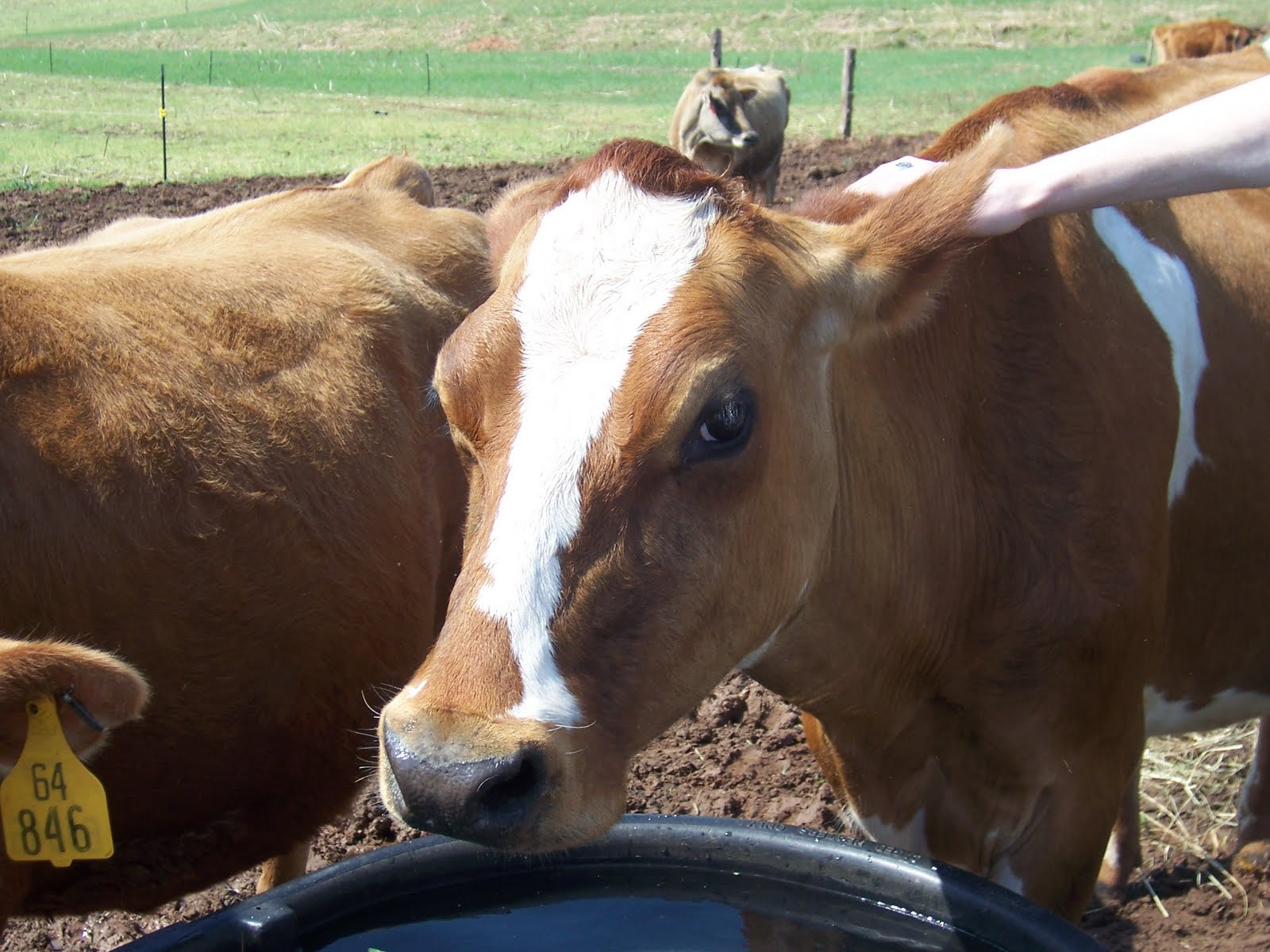
“Milk or meat, which one do you want?” That’s what the one cow seemed to be saying to me once the women had whirled away. I could see it in those cow-brown eyes that might have come up close to a fence to share dialogue or a careful blink with me . . . and it reminded me of all these cow pictures I took when I was at the Benedictine monastery in the Shenandoah Valley last springtime. The Benedictines, also called Trappist monks, are a priestly order which dates back to their founder, St. Benedict of the early 6th century. In addition to vows of silence and poverty, they have taken a vow of hospitality – which includes hosting those of us who live in this noisy world and would like to experience an occasional week of silence in the bucolic bounty of their farmland and monastic world.
And so, as I took my long walks along the Shenan- doah River last spring, the cows would amble over to the fence with little to say or do except for the presentation of themselves. One curious cow would begin the amble – and then you’d think a dinner bell had been rung, for they’d all begin to amble as the first one had – and so, if I waited long enough, they’d all make it to the fence for a good staring session. Many animals and birds have a kind of wisdom in the eye – but not the cow. They know nothing more about me than my desire for milk or meat.
I think the cow is the most resigned of all the creatures. They have no fight left in them. They have no flight either. They have lived thousands of years within fenced lines that are monitored by maidens or dames, farmers or “hands” – and through evolutionary learning they know that they are one thing or the other – milk or meat – and so they’ve resigned to say nothing more about it.
That’s the look I got from that one cow in the gallery. I ambled on to the next cow – and though her colors be different and her snapshot painting be taken at dusk or dawn, and though her profile be tilted or straight-on – still, she had that one question in her eye about the milk or the meat. But I never got bored of looking at the same question. Each cow is like a different, but familiar, breed of motherly love that has resigned itself to always give and never take. There’s no boredom in looking at her because taking is never boring for the taker – we can take till kingdom come and always think it is novel and fresh. Only the cow herself has grown bored with the equation.
Now, as for color – all the cows he painted, even the black and white ones, had so many feminine colors in their coats – or rather, hides – pinks, lavenders, purples, cantaloupe, chartreuse, and chive . . . I can’t say how it is that I could stand at one end of the gallery and look straight into the brown of a cow’s eyes at the other end of the gallery – and swear that she was a brown cow – only to walk closer and begin to see what the two women had come to see – lavender strokes and pink swirls, a curlicue of red, dabs of green, blue, or musk – as though the artist had been cleaning off his pallet on the cow’s hide instead of painting her. And, I thought, how can all those many colors converge – as you walk backwards and away from her – to make one brown cow with the eye of one question? How can a person, working in close range to a large canvas, think to add lavender and pink and chartreuse to a cow that he meant all along to be one brown cow . . . and how do you bury that one question in the cow’s eye only by adding a small blotch of red and a slice of white? It reminds me of what Barbara Ueland says in her book, “If You Want to Write” – she calls it the "fourth dimension" of writing – a type of inspiration that pervades the sentence but can’t be found in the words themselves no matter how much you scratch at the page – it’s just there.
Similarly, as I looked at the paintings, I could almost smell the fresh growing spring grass and taste the raw milk that I remembered from my grandfather’s farm. I also thought of the Chartreuse liqueur which I keep in the food cabinet – that wonderful “elixir of life” that was developed 400 or 500 years ago among the Carthusian monks in the French Alps. They are known for their silence, animal husbandry, heritage cheeses, and this elixir made from 130 herbal extracts – described as having hints of everything bucolic: citrus, violet, honey, thyme, rosemary, jasmine, coriander . . . on and on, 130 herbs and flowers. They say only three monks are alive today who know this secret recipe, and all three have taken a vow of silence in the Grande Chartreuse Monastery in the French Alps. The websites that market Chartreuse liqueur jokingly tell us that the Carthusian monks spent 500 years sampling and contemplating this 110-proof liqueur before declaring it a perfection which “redefines complexity.” But I think it took 500 years of looking closely into the eye of one cow to understand multiplicity where others saw only brown.
And so, this man’s cow paintings – they captured the “cow presence” – my unprofessional opinion – and I would easily have taken one home if I’d had $3,000 or more, but . . .
this is where I think of the two women who came whirling through the gallery while I stood in silent dialogue with one cow – they came whirling through together as though on a shopping spree to find just the right scarf or shoe, or fabric or lamp – they did not stop at any one cow, but rather whirled by and around me with such comments as, “That one would bring out the yellow in your drapes” – or, “This one would accent the green lamp” – or, “You need a touch of red in that room, here it is” . . . but the main shopper, close behind, did not seem overly impressed by her friend’s “good eye” – or the cow’s – and so they whirled through and out before the one cow and I could finish our silent understanding . . .
“Milk or meat, which one do you want?” That’s what the one cow seemed to be saying to me once the women had whirled away. I could see it in those cow-brown eyes that might have come up close to a fence to share dialogue or a careful blink with me . . . and it reminded me of all these cow pictures I took when I was at the Benedictine monastery in the Shenandoah Valley last springtime. The Benedictines, also called Trappist monks, are a priestly order which dates back to their founder, St. Benedict of the early 6th century. In addition to vows of silence and poverty, they have taken a vow of hospitality – which includes hosting those of us who live in this noisy world and would like to experience an occasional week of silence in the bucolic bounty of their farmland and monastic world.
And so, as I took my long walks along the Shenan- doah River last spring, the cows would amble over to the fence with little to say or do except for the presentation of themselves. One curious cow would begin the amble – and then you’d think a dinner bell had been rung, for they’d all begin to amble as the first one had – and so, if I waited long enough, they’d all make it to the fence for a good staring session. Many animals and birds have a kind of wisdom in the eye – but not the cow. They know nothing more about me than my desire for milk or meat.
I think the cow is the most resigned of all the creatures. They have no fight left in them. They have no flight either. They have lived thousands of years within fenced lines that are monitored by maidens or dames, farmers or “hands” – and through evolutionary learning they know that they are one thing or the other – milk or meat – and so they’ve resigned to say nothing more about it.
That’s the look I got from that one cow in the gallery. I ambled on to the next cow – and though her colors be different and her snapshot painting be taken at dusk or dawn, and though her profile be tilted or straight-on – still, she had that one question in her eye about the milk or the meat. But I never got bored of looking at the same question. Each cow is like a different, but familiar, breed of motherly love that has resigned itself to always give and never take. There’s no boredom in looking at her because taking is never boring for the taker – we can take till kingdom come and always think it is novel and fresh. Only the cow herself has grown bored with the equation.
Now, as for color – all the cows he painted, even the black and white ones, had so many feminine colors in their coats – or rather, hides – pinks, lavenders, purples, cantaloupe, chartreuse, and chive . . . I can’t say how it is that I could stand at one end of the gallery and look straight into the brown of a cow’s eyes at the other end of the gallery – and swear that she was a brown cow – only to walk closer and begin to see what the two women had come to see – lavender strokes and pink swirls, a curlicue of red, dabs of green, blue, or musk – as though the artist had been cleaning off his pallet on the cow’s hide instead of painting her. And, I thought, how can all those many colors converge – as you walk backwards and away from her – to make one brown cow with the eye of one question? How can a person, working in close range to a large canvas, think to add lavender and pink and chartreuse to a cow that he meant all along to be one brown cow . . . and how do you bury that one question in the cow’s eye only by adding a small blotch of red and a slice of white? It reminds me of what Barbara Ueland says in her book, “If You Want to Write” – she calls it the "fourth dimension" of writing – a type of inspiration that pervades the sentence but can’t be found in the words themselves no matter how much you scratch at the page – it’s just there.
Similarly, as I looked at the paintings, I could almost smell the fresh growing spring grass and taste the raw milk that I remembered from my grandfather’s farm. I also thought of the Chartreuse liqueur which I keep in the food cabinet – that wonderful “elixir of life” that was developed 400 or 500 years ago among the Carthusian monks in the French Alps. They are known for their silence, animal husbandry, heritage cheeses, and this elixir made from 130 herbal extracts – described as having hints of everything bucolic: citrus, violet, honey, thyme, rosemary, jasmine, coriander . . . on and on, 130 herbs and flowers. They say only three monks are alive today who know this secret recipe, and all three have taken a vow of silence in the Grande Chartreuse Monastery in the French Alps. The websites that market Chartreuse liqueur jokingly tell us that the Carthusian monks spent 500 years sampling and contemplating this 110-proof liqueur before declaring it a perfection which “redefines complexity.” But I think it took 500 years of looking closely into the eye of one cow to understand multiplicity where others saw only brown.
Thursday, April 15, 2010
Great Indices
A couple years ago I took a techno- logy class in which the professor opened the semester by asking us, “What forms of technology do you see around you?” And of course we adult students, like children with an eager eye to please, called out all those things we could see in the technology room including some in our own possession. It was a trick question – as we should have known – for she then proceeded to pick up a pencil and ask if this was not also a form of technology – her segue into the definition of technology: any tool that can facilitate and better our lives. The rest of the semester was devoted to computers and all that they can do for our lives, but the presentation of the pencil as a form of technology was one I could easily grasp and remember. I’m a big fan of the pencil, the paper clip, the pen, and the black and white composition book – technology at its best. However,
I’ve become greatly disturbed these past few weeks about the index card. The index card has also facilitated my life. They are good for note taking and list making, of course – but also for bookmarks, packing labels, recipe cards, vocabulary lists, signs, flashcards, to-do lists, notes to oneself or others . . . they can be cut into any size, shuffled, laid out on a table, stacked and rubber banded, paper clipped, grouped and regrouped . . . and they will last for many years . . . and you can write on both sides. I’ve never been without a stock of index cards.
At first I thought I had made a terrible mistake – that Good Friday, two weeks ago – when I came home and unwrapped my new pack of index cards. These were not index cards, but rather rectangles of paper no stockier than printing paper. They were flaccid, couldn’t be shuffled at all, and when held up to the window – the window panes shown through.
My to-do list fell to the side, and a Good Friday quest began . . . two superstores, two office supply stores, an old drug store, a grocery store, and one fancy pen and stationery shop . . . and no quality index cards. They are all made of paper-stock paper – and I don’t like the bold colors and odd stripes.
Once home, I cranked up my “advanced technology” to go online and see if I could perhaps order this “simple technology.” This is what I’ve learned: 1) I’m not the only one who has noticed the sudden lack of quality in index cards – there is at least one forum devoted to this topic – and people are angry. 2) The index card goes back thousands of years – its name derives from a Greek word, to show; and from the Latin, to point, to inform – much like our index finger. Medieval monks used them to jot down important points. 3) They are called index cards because they are made of card-stock paper. 4) The standard index card is 3x5 inches; wooden file boxes were made to accommodate this card when creating the first library card catalogue in 1820 – which was the google of its day. 5) The general public wanted these cards too – and so they became available to all. 6) No one knows exactly when the card was cheapened – but it’s been recent – and it has been pervasive – Mead, Oxford, all the office supply brands are now made of cheap paper-stock paper. 7) However, the original library card, Levenger, has not changed – but it’s hard to find even online, and then it costs plenty, about $28 per 500 cards – and it is currently backordered indefinitely. Another brand, Exacompta, can be bought for $8 per 100 cards, not including shipping charges from France.
It’s interesting that the iPad made its debut on the same day that I quested for index cards. They say that 120,000 iPads sold the first day, and upwards of one million sold by the end of the first week. What does this indicate? I’m tempted to conclude that the decline of the quality index card is indicative of the decline of a nation, its culture, its priorities – at least one computer for every man, woman and child in America – but not a single quality index card to be had. But I remember what one guy said in the forum on index cards: “It’s an index card! Get on with your life!” He then provided a five-paragraph review of every index card he’s ever tried, concluding that, for the price, the Oxford Pentaflex was good enough for him – "chopped up printing paper that it is," he said. And that gave me an idea . . .
If manufacturers can chop up paper-stock paper to make their cheap index cards, then why can't the common person cut up card-stock paper to make an old-fashioned quality index card?
The young man at Kinko’s knew exactly what I was talking about. He showed me his portfolio of card stock paper, adroitly calculated how many 3x5 and 4x6 cards he could cut from a standard sheet, asked me how many cards I’d like, which colors, gave me a price, cut the paper in two minutes, boxed them up. I took out two cards, one in each hand, and snapped them in the air – yes, snapped – not flapped – but snapped.
"I never thought I’d have to make my own index cards," I said to him gratefully.
“Oh, believe me, you’re not the only one . . .” he said.
And that’s when I realized: 1) The common person does notice when our “little technology” has been made cheap; we cannot be hoodwinked by big manufacturers. 2) Big technology will never totally displace quality little technology. 3) If manufacturers cannot provide us with our little technology – we will make it ourselves – and they will lose an important market sector.
I’ve become greatly disturbed these past few weeks about the index card. The index card has also facilitated my life. They are good for note taking and list making, of course – but also for bookmarks, packing labels, recipe cards, vocabulary lists, signs, flashcards, to-do lists, notes to oneself or others . . . they can be cut into any size, shuffled, laid out on a table, stacked and rubber banded, paper clipped, grouped and regrouped . . . and they will last for many years . . . and you can write on both sides. I’ve never been without a stock of index cards.
At first I thought I had made a terrible mistake – that Good Friday, two weeks ago – when I came home and unwrapped my new pack of index cards. These were not index cards, but rather rectangles of paper no stockier than printing paper. They were flaccid, couldn’t be shuffled at all, and when held up to the window – the window panes shown through.
My to-do list fell to the side, and a Good Friday quest began . . . two superstores, two office supply stores, an old drug store, a grocery store, and one fancy pen and stationery shop . . . and no quality index cards. They are all made of paper-stock paper – and I don’t like the bold colors and odd stripes.
Once home, I cranked up my “advanced technology” to go online and see if I could perhaps order this “simple technology.” This is what I’ve learned: 1) I’m not the only one who has noticed the sudden lack of quality in index cards – there is at least one forum devoted to this topic – and people are angry. 2) The index card goes back thousands of years – its name derives from a Greek word, to show; and from the Latin, to point, to inform – much like our index finger. Medieval monks used them to jot down important points. 3) They are called index cards because they are made of card-stock paper. 4) The standard index card is 3x5 inches; wooden file boxes were made to accommodate this card when creating the first library card catalogue in 1820 – which was the google of its day. 5) The general public wanted these cards too – and so they became available to all. 6) No one knows exactly when the card was cheapened – but it’s been recent – and it has been pervasive – Mead, Oxford, all the office supply brands are now made of cheap paper-stock paper. 7) However, the original library card, Levenger, has not changed – but it’s hard to find even online, and then it costs plenty, about $28 per 500 cards – and it is currently backordered indefinitely. Another brand, Exacompta, can be bought for $8 per 100 cards, not including shipping charges from France.
It’s interesting that the iPad made its debut on the same day that I quested for index cards. They say that 120,000 iPads sold the first day, and upwards of one million sold by the end of the first week. What does this indicate? I’m tempted to conclude that the decline of the quality index card is indicative of the decline of a nation, its culture, its priorities – at least one computer for every man, woman and child in America – but not a single quality index card to be had. But I remember what one guy said in the forum on index cards: “It’s an index card! Get on with your life!” He then provided a five-paragraph review of every index card he’s ever tried, concluding that, for the price, the Oxford Pentaflex was good enough for him – "chopped up printing paper that it is," he said. And that gave me an idea . . .
If manufacturers can chop up paper-stock paper to make their cheap index cards, then why can't the common person cut up card-stock paper to make an old-fashioned quality index card?
The young man at Kinko’s knew exactly what I was talking about. He showed me his portfolio of card stock paper, adroitly calculated how many 3x5 and 4x6 cards he could cut from a standard sheet, asked me how many cards I’d like, which colors, gave me a price, cut the paper in two minutes, boxed them up. I took out two cards, one in each hand, and snapped them in the air – yes, snapped – not flapped – but snapped.
"I never thought I’d have to make my own index cards," I said to him gratefully.
“Oh, believe me, you’re not the only one . . .” he said.
And that’s when I realized: 1) The common person does notice when our “little technology” has been made cheap; we cannot be hoodwinked by big manufacturers. 2) Big technology will never totally displace quality little technology. 3) If manufacturers cannot provide us with our little technology – we will make it ourselves – and they will lose an important market sector.
Subscribe to:
Posts (Atom)